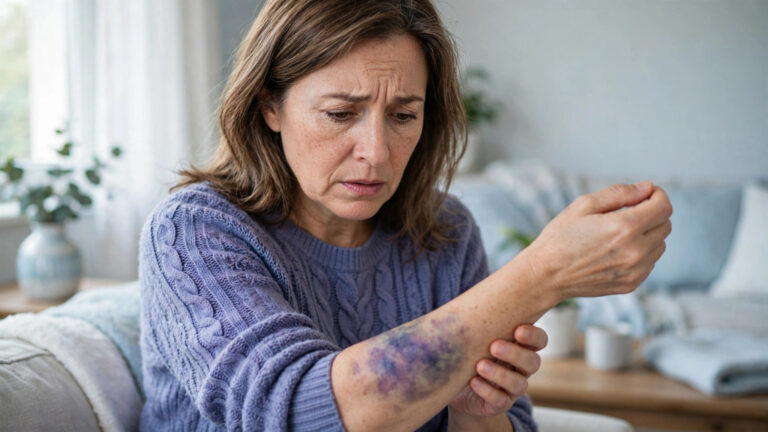
Fibromyalgia and Knee Pain: Why Stairs Became the Enemy
If you live with fibromyalgia and knee pain, stairs stop being architecture and become a decision. You count them from the bottom, choose your leading leg like a chess move, and negotiate with the handrail. Knees decide whether you can get down to a toddler, up from a low sofa, through a long walk, or through a night without the deep ache behind the kneecap narrating every position change.
The knee carries more load per square centimetre than any joint you own, multiplies your weight on stairs and squats, and depends entirely on the muscles around it for guidance, because its own shape offers almost no stability. In fibromyalgia those muscles are the problem’s headquarters: pain switches the quadriceps off, weakness lets the kneecap track badly, and the resulting grind generates real mechanical pain inside a condition already famous for amplifying it.
This guide explains how fibromyalgia and knee pain connect. First, you will learn the seven main reasons knees ache, swell and threaten to buckle. Next, you will find the strengthening programme that is, for most knees, the actual treatment. Finally, you will learn which knee signs mean the joint itself is injured or inflamed and needs assessment.
Table of Contents
- Why Fibromyalgia and Knee Pain Come Together
- 7 Reasons Your Knees Ache and Threaten to Buckle
- What It Feels Like Day to Day
- Fibromyalgia and Knee Pain: Building Steadier Knees
- When the Knee Needs Its Own Assessment
- Quick Questions
Why Fibromyalgia and Knee Pain Come Together
The chain is the story, because fibromyalgia and knee pain are set by the hip above and the foot below. The knee does not choose its alignment; the hip above and the foot below decide it, which is why our fibromyalgia and hip pain guide and our fibromyalgia and foot pain guide are secretly chapters of this one. Weak glutes let the thigh roll inward, flat or painful feet change the angle from below, and the knee, the hinge in the middle, collects the torque from both directions and complains on behalf of the whole leg.
Then the pain does its own damage. Quadriceps muscles inhibit within days of a knee hurting, through a reflex that protects in the short term and sabotages in the long term: the muscle that should absorb load steps aside, so cartilage and capsule absorb it instead, so the knee hurts more, so the muscle retreats further. This spiral, repeated in every joint article on this site, is at its most measurable in the knee, because thigh strength can be tested, trained and watched returning.
Cold and damp write their entries in knees before almost any other joint, a pattern our weather-sensitivity readers will recognise from their own diaries. Whether the mechanism is pressure sensitivity in sensitised tissues or the simple arithmetic of cold muscles and guarded movement, the practical translation is the same: winter knees need warming before loading, layers that actually cover the joint, and programmes that flex with the forecast instead of pretending the forecast is a character flaw.
The NHS knee pain guide covers the injuries and joint diseases doctors exclude. Fibromyalgia patients collect those at ordinary rates, osteoarthritis above all in midlife knees, and the amplification and deconditioning then sit on top. Two patients with identical X-rays can live in different knees entirely, depending on thigh strength and system sensitivity, which is the most hopeful sentence in this article and it is backed by every exercise trial ever run on the joint.
7 Reasons Your Knees Ache and Threaten to Buckle
Most people with fibromyalgia and knee pain have several of these at work. In fibromyalgia and knee pain, weakness and tracking usually lead:
1. Amplified pain around a normal knee. The condition’s background mechanism over the joint’s rich nerve supply, tracking flares and sleep, often with a completely clean examination.
2. Quadriceps shutdown and weakness. The thigh muscle inhibited by pain, producing the giving-way sensation, stairs dread, and the grind of a badly guided kneecap.
3. Kneecap tracking pain (patellofemoral pain). Ache behind or around the kneecap, worst on stairs, squats, hills and after long sitting, the famous cinema sign, where the knee must be straightened mid-film.
4. Osteoarthritis. Midlife wear of the joint surfaces: stiffness after rest, ache with load, swelling after big days, crepitus you can feel. It coexists with fibromyalgia constantly and answers the same strengthening programme.
5. Alignment torque from hip and foot. The chain problem above: knees paying for glute weakness and foot mechanics, often with pain on the inner knee where the torque concentrates.
6. Tendons and bursae. The patellar tendon below the kneecap, the pes anserine bursa on the inner knee, the iliotibial band on the outer: local, pressable, movement-specific pains that imitate joint disease and are not.
7. Stiffness and the morning gel. Knees that set after sitting and need their first steps walked out, the gelling phenomenon shared with the hip story, worse in cold and after still days.
The encouraging pattern in that list is how much of it is trainable. Tendons, tracking, alignment, stiffness and shutdown all answer loading programmes; only the assessment-list items truly need medicine’s heavier machinery. Most fibromyalgia knees are not broken. They are undertrained inside a loud nervous system, and both halves of that sentence have treatments.
What It Feels Like Day to Day

Day to day, fibromyalgia and knee pain are measured in furniture heights. Live with fibromyalgia and knee pain and every chair in the world gets silently graded. Low sofas, low cars, low toilets and floor-level anything become classified information you gather about every new house and café. Getting down is a controlled fall with a plan; getting up is a negotiation involving arms, leverage and occasionally an audience. People describe planning supermarket trips around which entrance has the ramp, and holidays around a single question nobody puts in the brochure: how many stairs?
Kneeling quietly leaves the repertoire too, and takes its small ceremonies with it: gardening at ground level, playing on the floor, bathing children, fixing anything stored low. People adapt with kneelers, stools and long-handled everything, and the adaptations are good ones, but they should be recorded as the symptom’s true cost, because “ache, 6 out of 10” has never once captured a grandfather declining the floor. Treatment goals set in ceremonies recovered are the ones patients actually train for.
The buckling threat adds a fear layer the ache alone never would. A knee that has folded once, on a kerb, mid-crossing, rewrites your relationship with every staircase and escalator afterwards, and the protective limping that follows loads the other knee, the hips and the back in tribute. Much of the treatment below is aimed less at the pain score than at this trust, because a knee you trust changes how a whole body moves through the world.
Fibromyalgia and Knee Pain: Building Steadier Knees
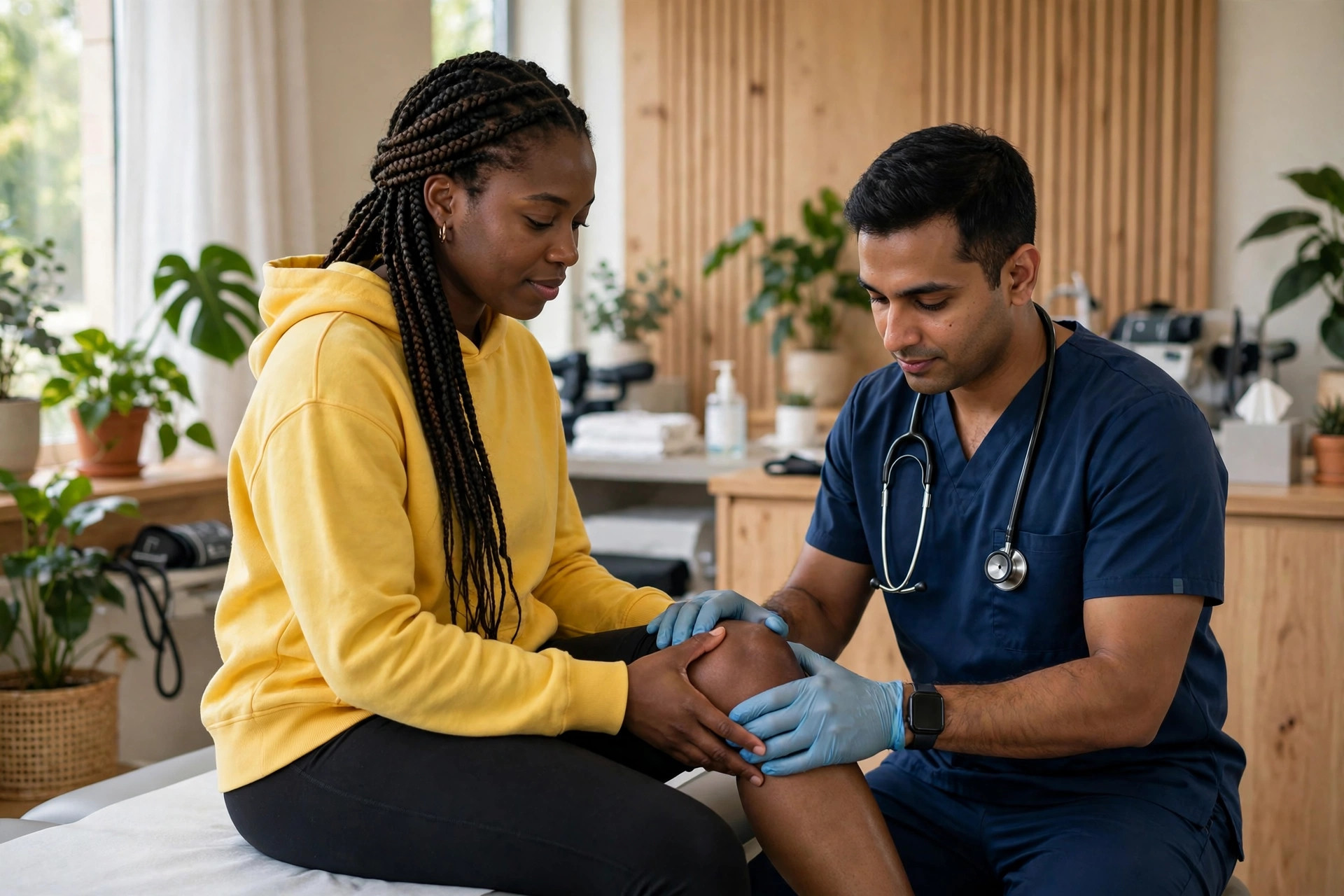
For most knees in this condition, exercise is not the support act; it is the treatment. For people managing fibromyalgia and knee pain, the programme that works is below. In fibromyalgia and knee pain, the thigh is the pharmacy:
Wake the quadriceps up first. Straight-leg raises, quad sets pressing the knee into the bed, and sit-to-stands from a high chair, dosed daily. The inhibited muscle needs invitations in writing before it returns to work, and its return is the single strongest predictor of a quieter knee.
Progress the load like medicine. Step-ups to a low step, chair squats to a cushion target, wall sits in short holds, increased by small weekly increments. Soreness the next day that settles within 24 hours is the correct weather; pain that escalates for days means the dose, not the programme, was wrong.
Train the chain, not just the joint. Glute bridges and hip work from the hip pain guide, calf raises, and foot strengthening, because the knee’s alignment is set by its neighbours. A knee-only programme in a chain problem is a letter sent to the wrong address.
Use stairs as training, on schedule. One step at a time with the good leg leading up and the bad leg leading down, the classic mnemonic, handrail unashamed, progressing to reciprocal stairs as strength allows. Avoided stairs weaken; dosed stairs strengthen; the difference is entirely in the planning.
Manage load across the week. Big walking days spaced, hills introduced by the calendar, footwear with cushioning and support, and weight discussed once as physics, exactly as kindly and briefly as in the hip guide, because knees multiply every kilo by four on the stairs.
Test the stairs monthly. Same staircase, same count, note the leading leg, the rail use and the recovery time. People rebuilding fibromyalgia and knee pain on that evidence persist through the slow middle weeks, because fibromyalgia and knee pain improve in rail-fingers released and landings taken standing, units that feelings overlook and staircases record faithfully.
Ice, heat and patience for the flare days. Cold for the hot, swollen post-effort knee; warmth for the stiff morning one; and the 24-hour rule governing tomorrow’s dose. Flares are weather in this programme, not verdicts, and the programme resumes at the previous level, never from zero.
When the Knee Needs Its Own Assessment
Most fibromyalgia and knee pain is muscle, tracking and amplification. Nevertheless, get the knee assessed if you notice:
- A knee that locks, catches, or gives way with a true mechanical block, which suggests a meniscus or loose body problem
- Swelling within hours of an injury, or a knee that will not bear weight after trauma
- A hot, red, swollen knee with fever, which is an urgent, same-day presentation
- True buckling with falls, beyond the weak-muscle wobble, especially with numbness or back pain
- Pain that localises to one bony point and keeps progressing, or night pain that is new and unrelenting
- A knee that stays swollen for weeks without injury, which widens the search to inflammatory causes
Assessment covers stability, strength, alignment and gait, with imaging where the pattern demands. The NHS fibromyalgia overview explains how physiotherapy and orthopaedic referrals fit your care. Surgical problems exist in fibromyalgia knees at the same rate as everyone else’s, and the label must never be allowed to retire them unheard.
Quick Questions
Why does my knee give way if nothing is torn?
Usually because the quadriceps switched off mid-task. Giving way in this condition is most often a strength and reflex failure, the muscle’s timing arriving a fraction late on a stair or kerb, rather than a structural collapse. The fix is the unglamorous one in this article: rebuild the muscle and its timing with progressive loading, and the folding episodes fade in frequency as the numbers climb. True mechanical giving way with locking belongs on the assessment list above, because its causes are different and some are surgical.
Is walking good for arthritic knees in fibromyalgia?
Yes, dosed. Cartilage has no blood supply and feeds by the pumping of loaded movement, so the arthritic knee deteriorates with rest and maintains with use. The dose rules are the ones above: flat before hills, distance built in percentages, the 24-hour soreness rule as referee. People who walk their osteoarthritic knees daily, at their dose, consistently report less pain within two months than people protecting the same X-rays on the sofa.
Do supplements like glucosamine help knee pain?
The evidence is weak and mixed, and the honest answer is that they are, at best, a distant second to the loading programme in this article. If a supplement seems to help you personally and is safe with your medicines, clinicians rarely object; the objection is to supplements instead of strengthening, funded monthly while the free treatment goes undone. Spend first on shoes, a step and a physiotherapy session. The thigh muscle remains the best-evidenced knee medicine ever tested.
Should I wear a knee brace?
As scaffolding, sometimes; as a lifestyle, rarely. A simple sleeve adds warmth and proprioceptive feedback that many people find genuinely steadying, and a hinged brace has its place for true instability under advice. What braces should not do is replace the muscle work, because the thigh inside a permanent brace weakens on schedule. Use support to enable the programme, taper it as the programme works, and let a physiotherapist choose anything more serious than a sleeve.
Living with fibromyalgia and knee pain means your world is measured in stair counts and chair heights. Wake the thigh for your fibromyalgia and knee pain, train the chain, dose the stairs, respect the 24-hour rule, and let locking, hot or truly collapsing knees have their own hearing. Knees that are loaded kindly, in this condition, usually repay the kindness. If you are still building your wider plan, our first-year roadmap is a steady place to continue.
This article is for general information and education only and is not medical advice. A hot, swollen knee with fever, a knee that locks, or inability to bear weight after injury needs prompt medical assessment.