Fibromyalgia and Hypermobility: When Bendy Joints Hurt More
If you live with fibromyalgia and hypermobility, you were probably the child who won the party tricks: thumbs to forearms, knees that bent backwards, splits on demand. Then the tricks started charging interest. Joints that bend too far also stabilise too little, so your muscles work double shifts to hold you together, and in a body whose pain amplifier is already turned up, the overwork, the micro-strains and the occasional joint that slips half out of place add up to pain that standard fibromyalgia advice, stretch more, move freely, sometimes makes worse.
Hypermobility means joints moving beyond the normal range because the connective tissue, the collagen scaffolding, is more elastic than average. It runs in families, is commoner in women, and overlaps with fibromyalgia far more than chance allows: clinic studies repeatedly find hypermobility in a large share of fibromyalgia patients, and fibromyalgia-type pain in a large share of hypermobile ones. At its fuller end it becomes hypermobility spectrum disorder or hypermobile Ehlers-Danlos syndrome, conditions whose travelling companions, gut trouble, fatigue, autonomic symptoms, read like this website’s index.
This guide explains how fibromyalgia and hypermobility connect. First, you will learn how to recognise the bendy pattern in yourself, including the simple Beighton checks. Next, you will find the management that differs crucially from standard advice: stability before stretch, control before range. Finally, you will learn the signs that belong to the wider connective-tissue picture and deserve proper assessment.
Table of Contents
- Why Fibromyalgia and Hypermobility Come Together
- Recognising the Bendy Pattern: The Beighton Signs
- What It Feels Like Day to Day
- Fibromyalgia and Hypermobility: Stability Before Stretch
- Signs of the Wider Connective-Tissue Picture
- Quick Questions
Why Fibromyalgia and Hypermobility Come Together
The mechanism is honest physics, which is why fibromyalgia and hypermobility reinforce each other so efficiently. Ligaments are not just straps; they are sensors, reporting joint position to the brain. Elastic ligaments report late and vaguely, so the hypermobile body’s proprioception, its sense of where its joints are, runs on delayed data. Muscles compensate by guarding constantly, micro-correcting all day, and guarded, exhausted muscles in a sensitised nervous system are precisely the fibromyalgia recipe. Our fibromyalgia and clumsiness guide described the dropping, bumping and tripping from the outside; hypermobility is one of its commonest engines from the inside.
The overlap family is bigger than joints. The same connective tissue lines the gut, the blood vessels and the autonomic wiring, so the hypermobile population collects the dysautonomia of our fibromyalgia and POTS guide, the gut rebellion of the IBS articles, and fatigue out of proportion to everything, at rates nobody calls coincidence anymore. The NHS joint hypermobility syndrome guide sets out the recognised picture and its management, and patients who read it often describe the peculiar relief of a checklist that finally includes their weirdest symptoms.
Pregnancy writes a chapter of its own in this story. The hormones that prepare a pelvis for birth loosen every ligament in the body, so hypermobile women often date a step-change in pain, instability and pelvic problems to a pregnancy, and then collect a fibromyalgia label for the aftermath without the connective tissue ever being examined. If your history has that shape, the hypermobility question is owed to you at any age, because the management genuinely differs.
Age rewrites the evidence, cruelly. Joints stiffen over decades, so the 45-year-old whose fibromyalgia began at 35 may no longer pass the flexibility tests she would have aced at 15, and her hypermobility hides in her history: the party tricks, the dislocating knee at netball, the “double-jointed” childhood, the sprains that never stopped. History is a diagnostic instrument here, which is why the next section includes the past as well as the present.
Recognising the Bendy Pattern: The Beighton Signs
The standard screen is the nine-point Beighton score, the test that separates fibromyalgia and hypermobility from ordinary fibromyalgia alone, one point per side for each manoeuvre. Check yours gently, once, without forcing:
Little fingers that bend backwards beyond 90 degrees. Thumbs that can touch the forearm when bent back. Elbows that straighten beyond straight, hyperextending by more than 10 degrees. Knees that do the same when you stand. And one point for palms flat on the floor with straight knees. Scores of 4 or more (with age adjustments clinicians apply) indicate generalised hypermobility, and the score is evidence to bring to an appointment, not a self-diagnosis to conclude at home.
One caution belongs inside the test itself: perform each movement once, to its natural stop, and never train towards a higher score. The Beighton is a measuring instrument, not a fitness goal, and the joints you are checking are precisely the ones this article will shortly advise you to stop taking to their end ranges for entertainment or exercise.
Beyond the score, the pattern has a biography: recurrent sprains from trivial twists, joints that sublux, slipping partway out with a clunk and a fright, or fully dislocate; soft, stretchy or fragile skin in the fuller syndromes; clicking everywhere; and pain characteristically worse at day’s end, because the muscles’ double shift accumulates, rather than on waking. People with fibromyalgia and hypermobility also recognise the paradox that confuses their clinicians: they are simultaneously the stiffest and the bendiest people in any room, rigid with guarding over joints built too loose, and both halves of that sentence are true at once.
What It Feels Like Day to Day
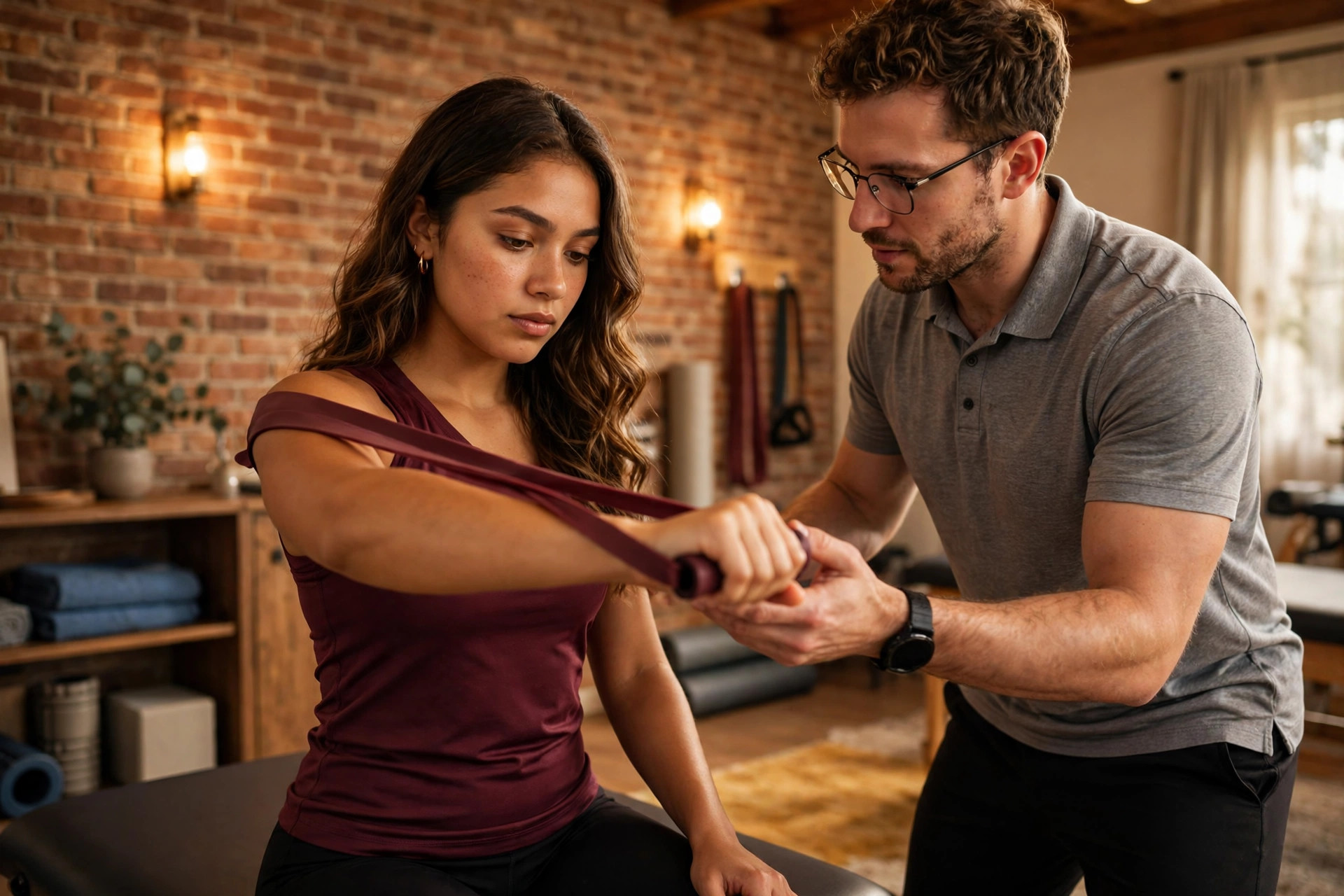
Day to day, fibromyalgia and hypermobility feel like living in a house whose hinges are all slightly loose, and fibromyalgia and hypermobility together make stillness the hardest exercise: everything works, everything rattles. Ankles roll on flat ground. Knees and shoulders clunk through their range like badly hung doors. Grip fails on jars not from weakness alone but because the finger joints bend backwards under load instead of transmitting it. Writing hurts in twenty minutes because the thumb’s stabilisers are doing architecture’s job with rope.
Sitting still in a cinema or a long drive becomes its own endurance event, because ordinary chairs ask the trunk’s stabilisers for continuous quiet work that hypermobile muscles cannot delegate to ligaments. People shift, cross, uncross, perch and slump in rotation, and get read as restless, fidgety or anxious in rooms where they are actually doing unpaid physiotherapy on themselves, minute by minute, just to remain upright without pain.
The fatigue has a specific flavour here, a deep muscular exhaustion by evening that rest does not fully clear, because the guarding never fully clocks off, even in chairs, even, some nights, in sleep positions that let joints drift to their end ranges and ache there. Partners notice the fidgeting first: hypermobile bodies micro-adjust constantly, hunting for the mid-range their ligaments cannot report, and stillness, the thing everyone prescribes for pain, is genuinely the hardest position of all.
Fibromyalgia and Hypermobility: Stability Before Stretch

Management here reverses the usual fibromyalgia instinct. For people managing fibromyalgia and hypermobility, the programme that works is below. In fibromyalgia and hypermobility, control is kinder than range:
Strengthen in mid-range, and stop worshipping stretch. The hypermobile body does not need more range; it needs control of the range it has. Resistance work through the middle of movements, isometric holds, and slow eccentrics build the muscular scaffolding the ligaments fail to provide. Aggressive stretching into end ranges, including much party-trick yoga, usually bills you later.
Train proprioception like a sense, because it is one. Balance work, eyes-closed stands near a support, wobble cushions, and slow precise movement drills sharpen the joint-position reporting that elastic ligaments blur. Our fibromyalgia and knee pain programme’s chain logic applies double here: the steadier the signal, the less the guarding, the lower the pain.
Protect the worst joints tactically. Splints and supports for the tasks that overload specific joints, writing, gripping, standing shifts; taping for sport; footwear that gives ankles an external wall. Supports in hypermobility are not the weakness-permitting crutch of myth; they substitute for tissue that is structurally absent, which is what all good tools do.
Pace the double shift. The hypermobile muscle budget is spent faster because it is spent on stabilisation as well as movement, so pacing plans calibrated to ordinary fibromyalgia underestimate it. Build rest into standing and gripping tasks specifically, and treat end-of-day exhaustion as data about load, not as failure of character.
Handle subluxations calmly and log them. Most partial slips reduce with gentle traction and rest, and a physiotherapist can teach your specific joints’ tricks. Frequency is the metric that matters: a joint slipping weekly needs its programme escalated and possibly imaging, while one that slips yearly needs a plan, not a panic.
Support the night shift too. Pillows that stop knees and shoulders drifting to end range, a pillow hugged to park the top arm, mattress firmness reviewed. People stabilising fibromyalgia and hypermobility often find sleep positioning buys the largest pain reduction per pound spent, because fibromyalgia and hypermobility both tax joints that drift unguarded for eight hours.
Bring the whole picture to one appointment. Joints, gut, autonomic symptoms, fatigue, skin, family history, laid out together. The wider syndromes are diagnosed on pattern across systems, and no single-system appointment ever sees the pattern whole. The NHS fibromyalgia overview explains how rheumatology referrals fit; hypermobility-aware physiotherapy is the referral to ask for by name.
Signs of the Wider Connective-Tissue Picture
Most fibromyalgia and hypermobility is manageable with the stability programme. Nevertheless, get a proper connective-tissue assessment if you notice:
- Repeated full dislocations, or joints that sublux weekly despite strengthening
- Skin that is unusually stretchy, fragile, tears easily, or scars wide and thin
- Easy, dramatic bruising without injury, or hernias and prolapse at a young age
- A family history of arterial or organ rupture, or sudden death at a young age, which changes the genetics conversation entirely
- Eye problems such as lens dislocation or severe early myopia alongside the joint picture
- Tall, long-limbed build with chest wall shape changes, which belongs in the same referral
Assessment covers the Beighton score with your history, skin and family review, and genetic referral where the pattern suggests the rarer, vessel-affecting Ehlers-Danlos types, because those change surveillance completely. Most people will land in the hypermobility spectrum or hypermobile EDS categories, managed with exactly the programme above; the assessment exists to make sure the minority who need more are never missed by reassurance.
Quick Questions
Can hypermobility be why my fibromyalgia exercises hurt?
Very plausibly, yes. Standard programmes dose stretching and end-range movement that a hypermobile body experiences as repeated micro-strain, and the post-exercise flare that patients report gets misread as ordinary fibromyalgia soreness. The tell is location and timing: pain at the joints themselves, worst that evening and the next day, in the exact ranges you stretched. Rebuilt around mid-range strength and proprioception, the same person often tolerates, then enjoys, exercise for the first time in years.
Is hypermobile EDS the same as hypermobility?
No, they are neighbouring addresses on one spectrum. Simple joint hypermobility is a trait, bendy joints without wider symptoms. Hypermobility spectrum disorder adds symptoms, pain, instability, fatigue. Hypermobile EDS is the fuller clinical diagnosis, with criteria spanning skin, family history and systemic features. The management core, stability training, protection, pacing, is shared across all three, which is why you do not need to wait for the perfect label to start the programme that helps.
Does hypermobility improve with age?
The bend usually reduces and the bill often does not. Stiffening tissues lower Beighton scores across the decades, which is why older patients fail tests their younger selves would have passed, yet the accumulated joint wear, deconditioning and central sensitivity can keep pain steady or rising. The practical reading is hopeful rather than bleak: the stability programme works at every age, and its strength benefits compound, so the trajectory is genuinely steerable even when the collagen is not.
Should bendy children be wrapped in cotton wool?
No, and the evidence leans the other way: strong, active hypermobile children fare best, with sport chosen and coached sensibly rather than forbidden. The watchpoints are coaching that respects end ranges, prompt attention to recurrent sprains, and adults who believe the child whose joints ache after ordinary play. What those children need is what this whole article prescribes at adult scale: strength around the bend, adults who understand it, and nobody telling them the party trick is the problem’s whole story.
Living with fibromyalgia and hypermobility means your scaffolding was built elastic and your muscles have been paying the difference. Score the pattern of your fibromyalgia and hypermobility, strengthen the middle ranges, sharpen the joint sense, protect the worst offenders, and let dislocations, fragile skin or a worrying family history trigger the full assessment without delay. Stability, in this body, is not the opposite of flexibility; it is what makes flexibility safe. If you are still building your wider plan, our first-year roadmap is a steady place to continue.
This article is for general information and education only and is not medical advice. Repeated dislocations, unusually fragile skin, or a family history of sudden death or arterial rupture should be assessed by a doctor, who may arrange genetic referral.