Fibromyalgia and Raynaud’s: 7 Reasons Your Fingers Go White and Numb
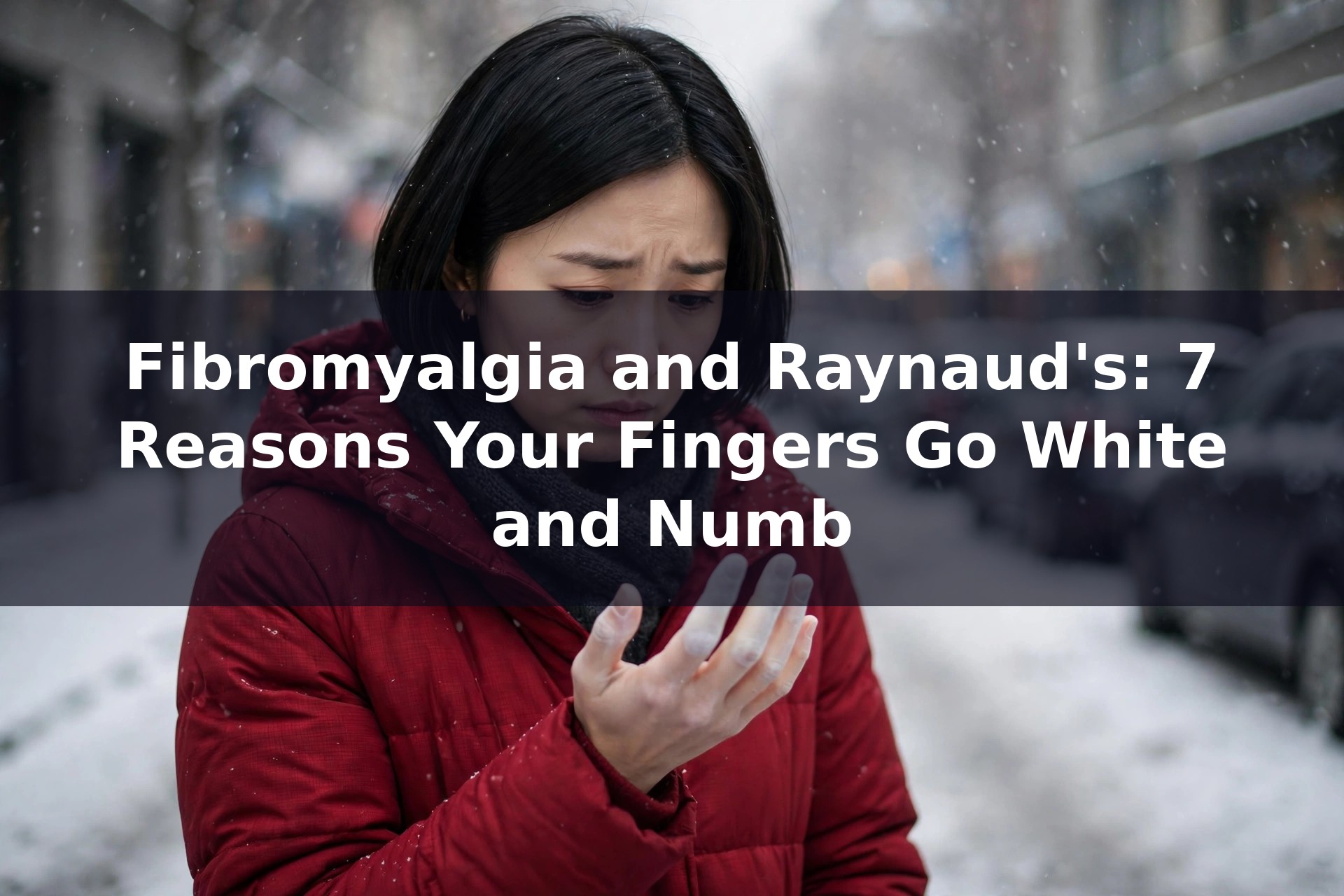
If you live with fibromyalgia and Raynaud’s, your fingers have a party trick nobody applauds. A cold aisle in the supermarket, a stressful phone call, the steering wheel on a winter morning, and two or three fingers drain of colour like a tap turned off: waxy white, then dusky blue, numb as wood, while the rest of your hand looks perfectly normal. Then the blood returns with a throb, bright red and stinging, and for ten minutes your hands burn as if you had insulted them personally.
Raynaud’s is a vasospasm: the small arteries in the fingers (and often toes, ears and nose) clamp shut far harder and longer than the cold warrants. In its primary form it is a standalone quirk, common, usually starting young, and harmless apart from the discomfort. In its secondary form it rides on another condition, and that distinction matters enormously, because secondary Raynaud’s can damage tissue and is a recognised early messenger of several autoimmune diseases. Fibromyalgia patients meet Raynaud’s often, partly because both conditions involve a nervous system that over-responds to signals, and the overlap deserves more than the shrug it usually gets.
This guide explains how fibromyalgia and Raynaud’s connect. First, you will learn the seven main reasons the attacks happen and why they cluster with this condition. Next, you will find the warming and prevention programme that cuts attack frequency. Finally, you will learn the signs that separate harmless primary Raynaud’s from the secondary form that needs blood tests, nailfold examination and a specialist’s attention.
Table of Contents
- Why Fibromyalgia and Raynaud’s Come Together
- 7 Reasons Your Fingers Go White and Numb
- What It Feels Like Day to Day
- Fibromyalgia and Raynaud’s: The Warming Programme
- Signs Your Raynaud’s Needs a Secondary-Cause Workup
- Quick Questions
Why Fibromyalgia and Raynaud’s Come Together
Both conditions are, at root, disorders of over-response, which is where fibromyalgia and Raynaud’s begin. Fibromyalgia amplifies pain signals centrally; Raynaud’s amplifies a vascular signal peripherally, the sympathetic nervous system’s instruction to conserve heat executed like a fire drill. The NHS Raynaud’s guide describes the mechanism plainly: cold or stress triggers the narrowing, colour drains, and the return of blood brings the throbbing red phase. A nervous system already living at high gain, this population’s baseline, plausibly fires that drill oftener and holds it longer, and studies of fibromyalgia cohorts do find Raynaud-type symptoms reported far above general-population rates.
Our fibromyalgia and cold hands guide covers the broader territory of chronically cold extremities in this condition, the low-grade constant chill that never quite becomes an attack. Raynaud’s is the sharper instrument in the same drawer: episodic, colour-changing, demarcated, with a beginning and an end. Readers often have both, the cold baseline and the dramatic episodes, and our sensory sensitivity guide explains why the return phase, the burning throb as blood re-enters, is felt at double volume by a sensitised system.
Children notice first, as they did with the tremor: they hold your hand, recoil theatrically, and announce the temperature to the room. Teenagers with the primary form, and it often starts in the teens, build their own folklore around it, gloves in June, horror of the drinks fridge at parties, a whole identity assembled at the extremities. Naming it early in that age group matters beyond comfort, because the one-in-many whose pattern is actually secondary is usually identifiable in those years by exactly the asymmetry and severity the assessment section describes.
The practical reason to separate the two is treatment. Cold hands answer to general warming, thyroid checks and time. Raynaud’s answers to attack prevention, vascular medicines when needed, and, critically, to a one-time serious question that cold hands never ask: is something underneath this? That question structures the whole article.
7 Reasons Your Fingers Go White and Numb
Most people with fibromyalgia and Raynaud’s have several of these at work. Whether attacks began before thirty or after is the first sorting fact. In fibromyalgia and Raynaud’s, the onset age is the first diagnostic fork:
1. Primary Raynaud’s. The standalone form: starts in teens or twenties, symmetrical, both hands, no tissue damage, often runs in families. Uncomfortable, dramatic, and medically benign once confirmed.
2. An over-responsive sympathetic system. The fibromyalgia connection: stress, pain flares and poor sleep triggering attacks indoors at room temperature, because the trigger is the alarm, not the weather.
3. Cold exposure patterns. Freezer aisles, air conditioning, cold water, wet weather and wind chill: the classic environmental attacks, worst on the body’s coldest, least defended days.
4. Secondary Raynaud’s from autoimmune disease. Scleroderma, lupus, rheumatoid arthritis and others damaging or sensitising the vessels: later onset, asymmetry, more severity, sometimes ulcers. This is the reason on the list that changes management completely.
5. Medicines and substances. Beta blockers, some migraine and ADHD medicines, decongestants, and above all nicotine, which clamps vessels chemically for hours per cigarette.
6. Vibration and occupation. Years of vibrating tools injuring finger vessels (hand-arm vibration syndrome), and repetitive cold work, catering, outdoor trades, building the pattern occupationally.
7. Low body weight and poor general circulation. Less insulation, lower blood pressure and deconditioning leaving fingers first in line for every heat-conservation decision the body makes.
The colour sequence is the signature that separates this list from ordinary cold hands: white for the clamp, blue for the stasis, red for the return, in that order, with a border you could draw. Ordinary cold hands are pale and slow; Raynaud’s is theatrical and timed. If your episodes perform the full sequence, name the condition by its name at your appointment and bring the photograph the programme below asks for.
What It Feels Like Day to Day

Day to day, fibromyalgia and Raynaud’s tax the hands’ reliability in cold’s small print, and fibromyalgia and Raynaud’s together turn every freezer aisle into a timed event: frozen food becomes a timed operation, winter gardening retires, typing on numb fingers produces documents reviewed by feeling rather than sight, and zips, buttons, coins and keys all demand a dexterity that leaves with the blood and returns with the burning. People learn to run taps by temperature guesswork, a genuinely risky skill, because numb fingers cannot testify about scalding water.
Occupations audit the symptom without asking: healthcare and food work with their cold rooms and constant handwashing, musicians whose fingers are the instrument, mechanics and builders outdoors all winter, hairdressers in cold water half the day. Workplace adjustments, warm-water access, glove provision, task rotation out of the freezer runs, are the unglamorous machinery that keeps people in those jobs, and they are easier to win with a named diagnosis than with a reputation for complaining about the cold.
The social layer is embarrassment’s familiar cousin: shaking a hand that feels like a fish, explaining the corpse fingers at a checkout, photographs of your own hands looking borrowed from a ghost. And winter rearranges the map of life, heated gloves in October, holidays argued toward warm destinations, until the condition’s quietest symptom turns out to control the calendar.
Fibromyalgia and Raynaud’s: The Warming Programme

Attack prevention beats attack rescue, because a vessel that never clamps needs no rescue. For people managing fibromyalgia and Raynaud’s, the programme that works is below. In fibromyalgia and Raynaud’s, warmth is a system, not an accessory:
Warm the core, not just the hands. Vessels open for a body that feels warm overall: layers, a hat outdoors, warm drinks, a heated room before errands. Gloves alone on a cold body are a locked door with a welcome mat; the core temperature is the key.
Glove early, glove in layers. Gloves on before the cold reaches you, liners under mittens outdoors, hand warmers in pockets, and pre-warmed gloves for the car. Rewarming mid-attack is slow; the programme’s whole economy is in never triggering it.
Break attacks the warm-water way. Lukewarm, never hot, water or a warm body part (armpits work), gentle movement, and patience through the throb. Hot water on numb skin scalds without warning and sends vessels into a second spasm; the unglamorous temperature is the treatment.
Remove the chemical clamps. Stopping smoking is the single highest-yield step in this entire symptom, and the medicine list deserves the same audit as any other: ask which of your prescriptions narrow vessels and what alternatives exist. Never stop a prescribed medicine unilaterally for this article; several of them are load-bearing.
De-escalate the stress trigger. Attack-on-stress is the sympathetic system doing push-ups; paced breathing during the trigger moments, warm hands before known stressors (meetings, phone calls, presentations), and flare management generally all lower the attack count, because in this condition the alarm and the vessel are the same circuit.
Photograph an attack, once, properly. Both hands mid-episode, date and trigger noted. Specialists sorting fibromyalgia and Raynaud’s from that evidence read the demarcation and symmetry in seconds, because fibromyalgia and Raynaud’s separate cleanly from lookalike cold sensitivity on exactly those features, and the photograph survives the journey to the appointment that your thawed fingers cannot reproduce on demand.
Ask about vascular medicines when attacks run your life. Calcium channel blockers such as nifedipine are the standard first prescription for frequent or severe attacks, with other options behind them in specialist hands. Needing a tablet for a circulation problem is not a fibromyalgia failure; it is a vessel being treated as a vessel.
Signs Your Raynaud’s Needs a Secondary-Cause Workup
Most fibromyalgia and Raynaud’s is the primary, benign form. Nevertheless, get assessed, with bloods and nailfold examination where indicated, if you notice:
- Attacks beginning after the age of 30, especially if they are worsening
- One hand, or one or two fingers, consistently worse than the rest
- Sores, ulcers or slow-healing cracks on the fingertips, which need prompt review
- Attacks travelling with joint swelling, rashes, mouth ulcers, muscle weakness or swallowing difficulty
- A finger that stays discoloured, or pain that does not resolve after rewarming
- New Raynaud’s in a man, or alongside unexplained weight loss or fevers
Assessment takes the attack history and photographs seriously, examines the nailfold capillaries, and tests for the autoimmune conditions on the secondary list. The NHS fibromyalgia overview explains how referrals fit alongside your fibromyalgia care. A normal workup converts Raynaud’s back into a warming problem with a clean conscience; an abnormal one catches a disease at its earliest, most treatable whisper.
Quick Questions
Is Raynaud’s dangerous in the primary form?
Almost never, and the reassurance is earned rather than given: primary Raynaud’s, confirmed young, symmetrical, ulcer-free and blood-test-quiet, does not damage tissue, does not progress to the autoimmune diseases, and does not shorten anything except winter walks taken unprepared. Its dangers are practical, numb hands near hot water, drops and fumbles, miserable winters, rather than medical. The one condition on the reassurance is that the confirmation actually happened: a proper history, and bloods where the pattern asks for them, rather than a self-diagnosis at the freezer aisle.
Why do my fingers tingle and burn when the blood comes back?
That is reperfusion, and it is the attack’s invoice: starved nerves and vessels protesting as flow returns, amplified by a sensitised nervous system into the throb-and-sting phase everyone with the condition recognises. It is unpleasant and, in the primary form, harmless, usually ten to twenty minutes of it. What it should never be is escalating: pain that keeps rising, a finger that stays blue or black, or blistering afterwards are tissue-distress signs, and they belong in the assessment section above on the same day, not in the folklore of the condition.
Do chilblains mean my Raynaud’s is getting worse?
Not automatically, but they are the same neighbourhood reporting damage: chilblains are the itchy red-purple swellings that follow cold exposure in poorly circulating skin, and they favour exactly the fingers and toes Raynaud’s already starves. The rules are moisturise, never scratch them open, rewarm gradually rather than at the radiator, and show any that ulcerate or refuse to heal to a clinician, because broken skin on a poorly perfused finger is the one place this article’s reassurance runs out. Repeated severe chilblains also strengthen the case for the vascular medicines in the programme above.
Can fibromyalgia itself be the secondary cause?
Not in the way the secondary list means: fibromyalgia does not damage blood vessels or appear on the autoimmune register Raynaud’s specialists screen for. The honest model is overlap rather than causation, two over-responsive systems sharing one nervous system, each making the other’s weather worse. That is why the workup still matters in this population: carrying a fibromyalgia diagnosis explains the amplification, but it must never be used to wave away a new, asymmetric, late-onset Raynaud’s pattern that predates or outruns the usual story.
Living with fibromyalgia and Raynaud’s means your fingers keep filing weather reports in colour. Warm the core of your fibromyalgia and Raynaud’s first, glove early, rescue with lukewarm water, retire the chemical clamps, and let late onset, asymmetry or a fingertip sore bypass every queue in this article for the workup that settles the question once. If you are still building your wider plan, our first-year roadmap is a steady place to continue.
This article is for general information and education only and is not medical advice. Fingertip ulcers, a finger that stays discoloured, or Raynaud’s starting later in life needs prompt medical assessment.