
Fibromyalgia and Hip Pain: 8 Reasons Your Hips Ache & Stiffen
If you live with fibromyalgia and hip pain, your world quietly reorganises itself around chairs with arms, beds that are not too low, and cars you can fall into rather than climb out of. The hips decide whether you can sit through a film, sleep on your side, climb the stairs like an adult, or get through a workday without standing up like a folding ruler, one segment at a time.
Hip pain is one of the most functionally expensive symptoms in fibromyalgia because the hip is the body’s hinge: every sit, stand, step and turn routes through it. In this condition, “hip pain” is also a suitcase phrase containing several different pains, true joint pain, outer-hip tendon and bursa pain, groin pain, buttock pain, and pain referred from the lower back, all amplified by a nervous system that reports load as damage.
This guide explains how fibromyalgia and hip pain connect. First, you will learn the eight main reasons hips ache and stiffen. Next, you will find the strengthening and daily strategies that change the maths. Finally, you will learn which hip patterns belong to the joint itself and need proper assessment.
Table of Contents
- Why Fibromyalgia and Hip Pain Come Together
- 8 Reasons Your Hips Ache and Stiffen
- What It Feels Like Day to Day
- Fibromyalgia and Hip Pain: Building Stronger, Quieter Hips
- When Hip Pain Belongs to the Joint
- Quick Questions
Why Fibromyalgia and Hip Pain Come Together
The first service this article can do you is cartography, because fibromyalgia and hip pain is a plural disguised as a singular, because hip pain has addresses and the addresses have different owners. Pain on the outer hip, over the bony point you lie on, is usually the gluteal tendons and bursa, now grouped as greater trochanteric pain syndrome. Pain in the groin crease is the true hip joint clearing its throat. Pain deep in the buttock is often the back, the sacroiliac joint or the deep hip muscles. Fibromyalgia can host all of these, plus its own amplified muscle pain over the whole map, and each address has a different treatment, which is why generic hip advice disappoints so many people.
The tendons deserve a headline. The gluteal tendons that steady your pelvis with every step are load-bearing cables, and in deconditioned, fibromyalgia muscles they become overloaded and irritable, protesting at side-lying, stairs, hills and standing on one leg to dress. The NHS hip pain guide sets out the common causes and self-care doctors start from, and tendon pain’s behaviour, better with gentle load, worse with both rest and overuse, is the key pattern in this article.
Sitting deserves its own indictment. The hip flexors shorten through desk days, the glutes switch off in the chair that needs them most, and the joint itself stiffens in the folded position it is then asked to unfold from dramatically, in car parks, in front of colleagues. People are often surprised that their hip pain peaks not on walking days but on meeting days. The hip is a use-it-or-lose-it hinge, and modern work is a losing schedule written eight hours at a time.
Then the whole system adds its signature. Weak hip muscles from pain-avoidance make each step costlier; the gait compensations ripple into knees and backs, as our fibromyalgia and foot pain guide describes from the other end; and spasms in the hip’s deep rotators join the cast of our fibromyalgia and muscle spasms story. The hip sits at the crossroads of the condition, and traffic there is always heavy.
8 Reasons Your Hips Ache and Stiffen
Most people with fibromyalgia and hip pain have several of these at work. In fibromyalgia and hip pain, tendons and stiffness usually lead the cast:
1. Gluteal tendon overload (outer hip). The commonest single address: pain over the bony point, worst lying on that side, on stairs and after long walks, tender to press. It is a tendon capacity problem, treated with progressive load, not rest.
2. Amplified muscle pain. The condition’s background mechanism over the whole hip region, tracking flares, weather and sleep more than any single movement.
3. True hip joint wear and stiffness. Groin-dominant pain, stiffness after sitting, reduced rotation. Arthritis does not skip people with fibromyalgia, and midlife hips collect it honestly.
4. Referred back and sacroiliac pain. Buttock and posterior hip pain whose headquarters is the spine or the SI joint, arriving at the hip by nerve geography.
5. Morning stiffness and immobility. Hips set like cooling glue overnight and through long sitting; the first steps out of a chair perform the daily ungluing.
6. Deconditioning and gait compensation. Weak glutes let the pelvis drop and sway, multiplying tendon load and joint irritation with every step; the weakness and the pain maintain each other.
7. Sleep position warfare. Side-lying compresses the outer hip tendons; back-lying strains some backs; the nightly rotation between two painful options fragments sleep, which raises tomorrow’s pain volume.
8. Weight and load arithmetic. Hips multiply body weight with every step. This is physics, stated once and kindly, in a condition where load management is treatment and blame is not.
The addresses matter more than the count. Two people can recite identical pain scores and need opposite programmes, one loading a tendon, one protecting a joint, one treating a back that is visiting. Spending one appointment on cartography, whose pain lives where, is the highest-value step in this entire article.
What It Feels Like Day to Day

Day to day, fibromyalgia and hip pain edit the choreography of ordinary life. Watch one week of yours closely and fibromyalgia and hip pain will appear in almost every scene change. Getting out of low chairs becomes a planned manoeuvre with armrests as equipment. Shoes and socks require strategy, a stool, a long-handled aid, or a flexibility you no longer own. Stairs are taken one at a time on the bad days, in public, at other people’s pace, with a handrail doing honest work. Driving hurts twice, the sitting and the swivel out.
Floor life quietly retires, and it takes more with it than it announces: playing with children and grandchildren, gardening at ground level, yoga classes, picnics, the whole geography of down-there. People describe realising a year later that they have been declining floor-shaped invitations automatically. That is the correct way to measure this symptom’s cost and also the correct goal to set its treatment: not a pain score, but a recovered category of living, one floor-sit at a time.
Nights run the rotation shift described above: left side until the tendon complains, back until the spine does, right side until its tendon files a matching report. Partners learn the pillow architecture, the one between the knees, the one under the knees, that buys the longest truce. Sleep bought this way is still sleep, and in this condition sleep is currency, so the architecture is worth engineering properly rather than apologising for.
Fibromyalgia and Hip Pain: Building Stronger, Quieter Hips
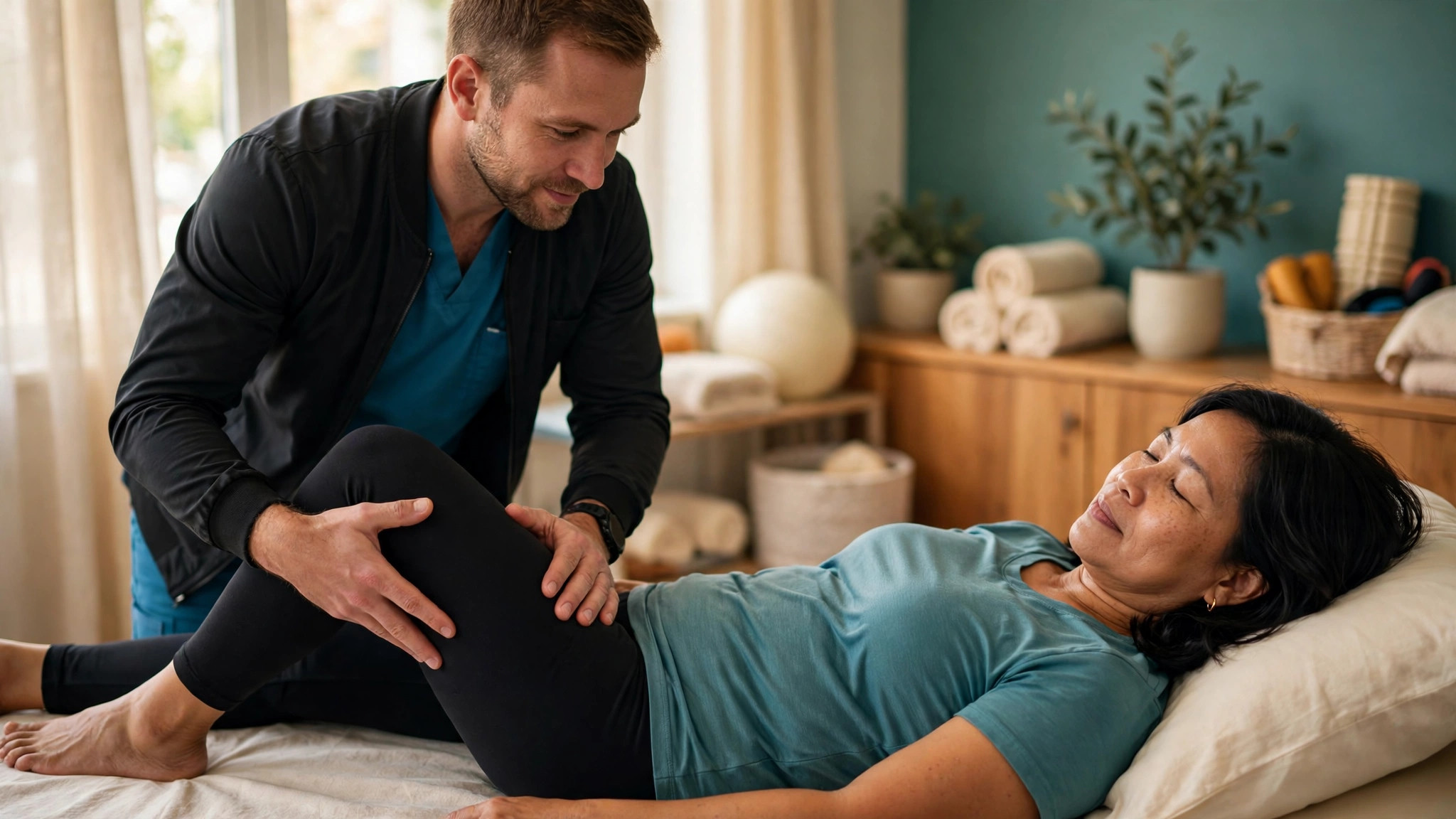
Hips in this condition improve with capacity, not caution. For people managing fibromyalgia and hip pain, the programme that works is below. Every item assumes fibromyalgia and hip pain together, load dosed like medicine:
Load the glutes progressively. Bridges, sit-to-stands from a raised chair, step-ups to a low step, side-lying or standing hip abduction, dosed gently and increased weekly. Tendons rebuild under load the way muscles do, slowly and measurably, and eight to twelve weeks is the honest trial period.
Stop squashing the outer hip. Avoid crossing legs, standing hanging on one hip, and lying directly on the sore side without a pillow between the knees. Compression plus load is the tendon irritant; removing the compression half is free treatment, available tonight.
Break up sitting before the ungluing hurts. Thirty-minute movement snacks, a lap of the room, three sit-to-stands. Hips stiffen by the clock in this condition, so the clock, not the pain, should schedule your standing.
Walk in doses the tendons accept. Flatter routes while irritable, hills and stairs reintroduced by the calendar, distance built in small percentages. Walking is the hip’s favourite medicine at the right dose and its favourite complaint at the wrong one.
Engineer the sleep position. Pillow between the knees for side-lying, a mattress topper that softens the point of the hip, and permission to rotate on schedule rather than on pain. The goal is not a perfect position; it is a longer truce per position.
Keep a two-week hip map. Which address hurts, groin, outer point, buttock, and when: nights, stairs, sitting, walking. People managing fibromyalgia and hip pain who arrive with that map get the right treatment stream in one appointment instead of three, because fibromyalgia and hip pain are treated by address, and the map is the address written down.
Use heat, hands and patience on the muscles. Warmth before movement, gentle self-massage of the glutes with a ball against the wall, and the spasm-release habits from the muscle spasms guide for the deep rotators. These manage today’s volume while the strengthening rebuilds tomorrow’s capacity.
When Hip Pain Belongs to the Joint
Most fibromyalgia and hip pain is tendon, muscle and amplification. Nevertheless, get the hip properly assessed if you notice:
- Groin pain that keeps progressing, with stiffness and loss of rotation, which is the hip joint’s own signature
- Pain after a fall or injury, any inability to bear weight, or a leg that looks shortened or turned out, which is urgent, same-day care
- Night pain in the hip that is new, unrelenting and present at total rest
- A hot, swollen hip with fever, which is an emergency
- Clicking with catching or giving way that keeps worsening
- Hip pain beginning after long steroid use, or in a younger person without injury, which widens the list of causes
Assessment covers movement, strength and gait, with X-ray or further imaging where the pattern demands, exactly because hip joints wear in ways exercises cannot reverse and replacements fix remarkably well. The NHS fibromyalgia overview explains how orthopaedic and physiotherapy referrals fit your care. Do not let a fibromyalgia label retire a hip joint that is asking for its own hearing.
Quick Questions
Why does my hip hurt more when I lie on it?
Because lying on the side compresses the gluteal tendons against the bone, and compression is half of that tendon’s complaint. The fixes are positional engineering: a softer topper, a pillow between the knees to change the tendon angle, or the other side while the sore one retrains. Pain that specifically forbids side-lying is one of the most tendon-flavoured clues in this whole article, and it usually improves as the strengthening programme rebuilds capacity.
Is walking good or bad for fibromyalgia hip pain?
Good, at the dose the hip votes for. Tendons and joints both deteriorate with rest and irritate with overload, so the therapeutic window is the middle: regular, mostly flat, gradually lengthening walks, with hills reintroduced like medicine, by dose. The hip that is loaded a little daily outperforms both the rested hip and the weekend-warrior hip within a couple of months, in pain, stiffness and confidence.
Should I use a walking stick or other aid?
If it buys you distance, yes, without a flicker of embarrassment. A stick in the opposite hand unloads the hip measurably, trekking poles spread the work across four limbs on longer walks, and both often convert an impossible outing into a completed one. Aids are dose-extenders for the exact medicine, walking, that hips need. The only rule is fit and instruction: a physiotherapist sets the height in two minutes and the difference is not subtle.
How do I know if it is my hip joint or my back?
Geography gives the first answer: groin and front-of-thigh pain usually comes from the joint; buttock and back-of-thigh pain usually comes from the back or SI joint; outer-hip pain is usually tendon. Movement gives the second: joint pain dislikes rotation, back pain dislikes bending patterns. A physiotherapy assessment resolves most remaining doubt in one visit, because each source has manoeuvres that provoke it specifically, and the distinction decides the entire treatment plan.
Living with fibromyalgia and hip pain means negotiating with the body’s hinge. Read the address of your fibromyalgia and hip pain before treating the ache before treating the ache, load the tendons patiently, stop squashing them at night, break up the sitting, and let groin-dominant or progressing patterns have their joint hearing. Hips that are trained, in this condition, usually grow quieter month by month. If you are still building your wider plan, our first-year roadmap is a steady place to continue.
This article is for general information and education only and is not medical advice. Hip pain after a fall, inability to bear weight, or a hot swollen hip with fever needs urgent same-day assessment.