
Fibromyalgia and Ankle Pain: Why Your Ankles Give Way
If you live with fibromyalgia and ankle pain, flat ground has stopped being trustworthy. Your ankle rolls on a pavement that offended no one else, aches by evening even on quiet days, swells inside shoes that fitted at breakfast, and occasionally folds in a doorway with no obstacle present at all. The ankle is the body’s first negotiator with the ground, and in fibromyalgia the negotiation keeps failing in ways that look like carelessness and are actually mechanics.
The ankle’s job is impossible by design: transmit the whole body’s weight through a joint the size of a fist, on surfaces that tilt, while reporting its position to the brain fast enough to prevent falls. Its ligaments are its sensors as much as its straps, and its tendons, the peroneals outside, the tibialis posterior inside, are its active stabilisers. Fibromyalgia degrades every part of that system at once: proprioception dulled, muscles inhibited by pain, tissues sensitised, and swelling from the autonomic story pooling exactly where gravity sends it.
This guide explains how fibromyalgia and ankle pain connect. First, you will learn the seven main reasons ankles ache, swell and roll. Next, you will find the balance and strengthening programme that is, for most ankles, the actual treatment. Finally, you will learn which ankle signs mean fracture, tendon rupture or joint disease and need prompt assessment.
Table of Contents
- Why Fibromyalgia and Ankle Pain Come Together
- 7 Reasons Your Ankles Ache, Swell and Roll
- What It Feels Like Day to Day
- Fibromyalgia and Ankle Pain: Rebuilding Ankles You Can Trust
- Ankle Symptoms That Need Prompt Assessment
- Quick Questions
Why Fibromyalgia and Ankle Pain Come Together
Start with the sprain that never graduated, because fibromyalgia and ankle pain usually began as an injury whose rehabilitation never finished. An ankle sprain tears ligament fibres and, with them, the position sensors inside the ligament; rehabilitated fully, the system relearns itself, but in a body avoiding movement through pain, rehabilitation quietly never completes, and the ankle keeps its degraded reporting for decades. Each subsequent roll is then easier, the classic chronic instability spiral, and fibromyalgia patients, whose exercise recovery is already rationed, collect unfinished ankles at remarkable rates. The NHS sprains and strains guide gives the standard recovery route whose final stage, balance retraining, is the part most often skipped and most needed here.
The chain speaks again, from below this time. Our fibromyalgia and foot pain guide describes the foot’s mechanics; the ankle sits directly on top of that machinery, inheriting every flat arch and stiff big toe as torque it must absorb. Above it, the swelling story of our fibromyalgia and swelling guide pools fluid at the ankle by evening, stiffening the joint and dulling its sensors further, which is why ankle trust so often expires in the afternoon.
Night adds a coda most joint articles miss. Ankles stiffen in bed like every fibromyalgia joint, but they also meet the day’s most dangerous metres in the dark: the bathroom route, half asleep, on feet whose sensors have been offline for hours. The first-steps hobble that everyone jokes about is a genuine fall window in this population, which is why the balance programme below quietly includes a bedside rule, sit, pump the ankles ten times, then stand, that has prevented more fractures than any supplement.
And the near-falls accumulate a psychology of their own, as our fibromyalgia and clumsiness guide records from the body’s wider map. A person who has rolled an ankle on holiday cobbles walks the world differently afterwards, eyes down, routes audited, curbs negotiated, and the cautious gait itself stiffens and weakens the ankle it protects. Treating this joint is always partly treating trust.
7 Reasons Your Ankles Ache, Swell and Roll
Most people with fibromyalgia and ankle pain have several of these at work. In fibromyalgia and ankle pain, old sprains usually hold the casting vote:
1. Chronic instability from old sprains. The unfinished-rehabilitation story above: an ankle that rolls recurrently on minor provocation, with ligaments reporting late. The commonest mechanical cause in this population.
2. Amplified pain. The condition’s background ache over the joint and its tendons, tracking flares and sleep, with a normal-looking ankle that hurts out of proportion to any load.
3. Peroneal tendon irritation (outer ankle). The stabilising tendons behind the outer bone, overworked by instability, ache and sometimes snap audibly during movement.
4. Tibialis posterior trouble (inner ankle). The arch-supporting tendon behind the inner bone: pain and swelling along it, an arch that flattens under load, and rising onto tiptoe on that side becoming difficult.
5. Evening swelling and stiffness. The fluid story: ankles that thicken through the day, shoes that tighten, range that shrinks by evening as the pooled fluid mechanically limits the joint.
6. Achilles and calf involvement. The great tendon above the heel shares the load story: morning stiffness, pain on hills and stairs, and a calf whose weakness unloads work onto the ankle’s smaller structures.
7. Joint wear and inflammatory disease. Post-injury arthritis in previously sprained ankles, and the inflammatory arthritides that include ankles in their rounds; both deserve identification rather than assumption.
Read the list by behaviour, not by anatomy alone: the ankle that rolls points to sensors, the one that aches by evening points to load and fluid, the one that flattens points to a tendon with a name. Behaviour is the cheapest diagnostic instrument at this joint, and it is sitting in your own diary.
What It Feels Like Day to Day

Day to day, fibromyalgia and ankle pain convert walking into surveillance. Live with fibromyalgia and ankle pain and every pavement gets a risk assessment. Cobbles, gravel, wet leaves, uneven lawns and unfamiliar kerbs are all audited in advance; beaches become obstacle courses; and the spontaneous walk, the kind other people take to clear their heads, requires route planning, footwear decisions and a phone for the rescue call you hope is theatre. People describe watching other people’s feet with envy, a sentence that sounds comic until you have lived inside it.
Dogs and grandchildren hold the ankle’s social diary. The dog’s walk is simultaneously the ankle’s best medicine and its highest-risk hour, grass, kerbs, sudden lunges at squirrels, and grandchildren’s games are played at ankle height on ankle-hostile terrain. People negotiate both with the same instruments they use everywhere else in this condition: route choice, footwear, timing, and the refusal to let one rolled afternoon delete a relationship’s favourite activity permanently.
Shoes become medical devices by default. The collection migrates towards ankle-covering, lace-fastened, thick-soled respectability, and the abandoned shelf of beautiful impractical footwear becomes a small museum of the former life. Evenings add the swelling coda: the ankle that was a joint at breakfast is a pudding by dinner, shoes are removed like a release, and legs go up on cushions in a ritual as fixed as any medication schedule.
Fibromyalgia and Ankle Pain: Rebuilding Ankles You Can Trust
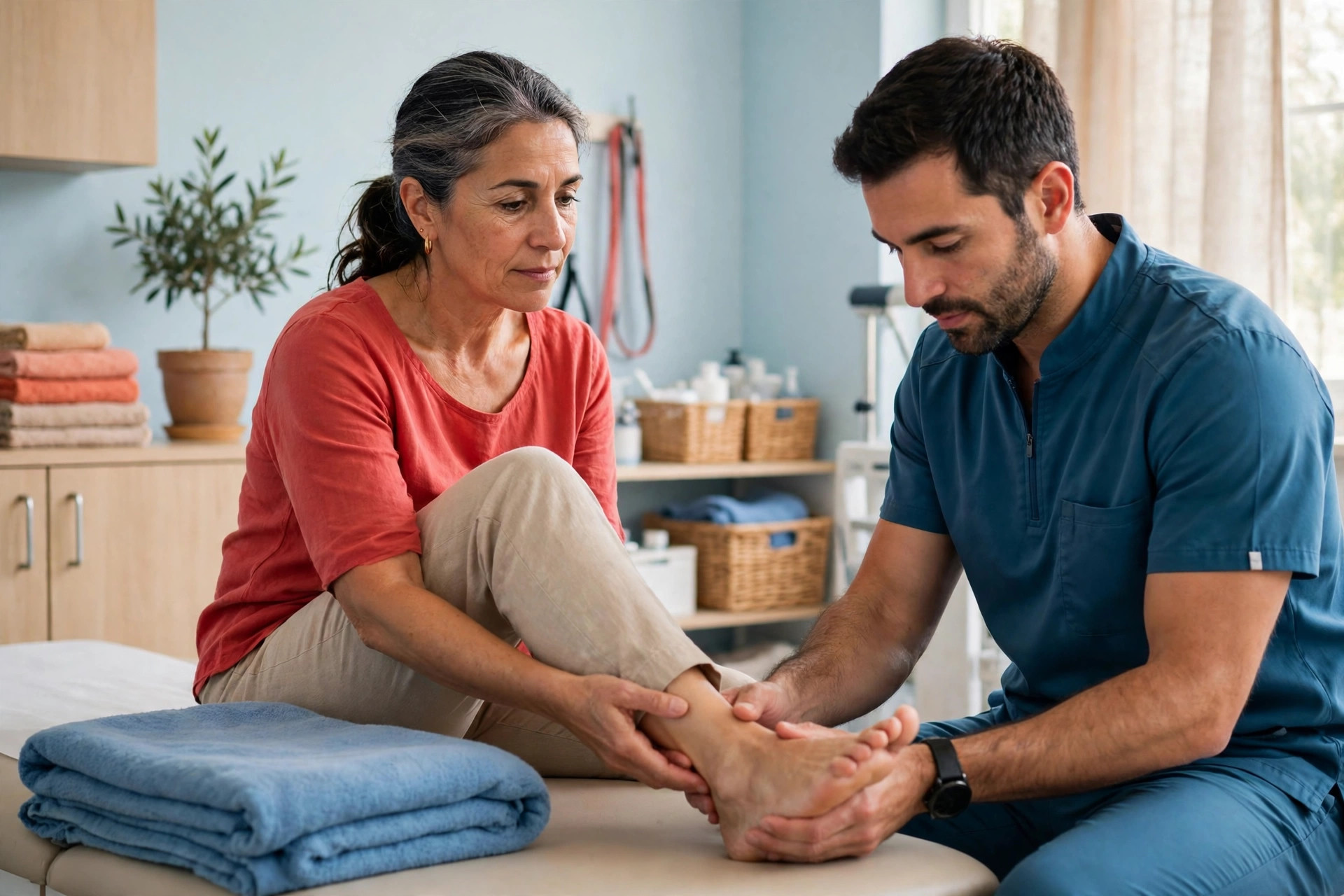
Ankles in this condition improve with retrained sensors and rebuilt strength. For people managing fibromyalgia and ankle pain, the programme that works is below. In fibromyalgia and ankle pain, balance is the medicine and shoes are the dose form:
Retrain balance like it is the treatment, because it is. Daily single-leg stands beside a support, progressing from eyes open to head turns to softer surfaces over weeks. Two minutes a day of this is the specific medicine for the ligament sensors, and the near-fall frequency is its honest scoreboard.
Strengthen the stabilisers. Heel raises progressing to single-leg, band-resisted eversion for the peroneals, and slow controlled step-downs. The ankle’s muscles are its only active defence, and in this programme they are trained as such, little and often, inside the fibromyalgia pacing rules.
Choose footwear as equipment. Firm heel counters, laces or straps that actually fasten, low broad heels, cushioned but not wobbly soles, and ankle support for the high-risk outings, cobbles, countryside, travel days. The beautiful impractical shelf can keep its museum status without adding exhibits.
Manage the evening fluid on schedule. Legs elevated before the swelling peaks, ankle pumps while elevated, compression where advised, and the walk-dosed day from the swelling guide. A less swollen ankle reports its position better, so fluid management is balance training by another route.
Graduate the terrain. Flat and familiar first, then lawns, then gentle trails, each promoted only when the current level stops producing rolls and next-day protests. Confidence rebuilt in verifiable stages is confidence that survives the first cobbled street of the next holiday.
Keep a near-fall log for one month. Every roll, wobble and rescue, with the surface, footwear and time of day. People rebuilding fibromyalgia and ankle pain on that evidence see the pattern indict itself within weeks, evening, garden, slippers, and fibromyalgia and ankle pain both respect a defendant identified that precisely.
After any fresh sprain, do the whole recovery this time. Protection and ice for days, then movement, then strengthening, then the balance stage everyone skips. A completed rehabilitation is the single best predictor that this sprain is the last one, and the balance work doubles as your ongoing programme without modification.
Ankle Symptoms That Need Prompt Assessment
Most fibromyalgia and ankle pain is instability, tendon load and amplification. Nevertheless, get assessed promptly if you notice:
- A sprain with inability to bear weight, severe swelling within hours, or bruising that spreads down the foot, which needs fracture excluded
- A snap or pop at the back of the ankle with sudden weakness pushing off, which can be an Achilles rupture and is time-critical
- An ankle that is hot, red and swollen with fever
- Progressive flattening of one arch with inner-ankle swelling, the tibialis posterior pattern that changes management entirely
- Recurrent giving way despite months of balance training, or a joint that locks or blocks
- Numbness, colour change or a cold foot alongside the pain
Assessment covers stability testing, tendon examination and weight-bearing, with imaging where the pattern demands. The NHS fibromyalgia overview explains how physiotherapy and orthopaedic referrals fit your care. Ankles that keep folding after honest retraining sometimes have a surgical chapter, and it is a successful one more often than patients fear.
Quick Questions
Why does my ankle roll when nothing is wrong with it?
Because the sensors, not the straps, are usually the damaged part. After sprains, the ligament’s position reporting arrives late, so the muscular correction that should fire in a fraction of a second fires after the roll has begun. The ankle looks normal on every scan because structurally it nearly is; its information system is what limps. That is precisely why balance retraining, which no scan can prescribe and no tablet can replace, is the treatment with the evidence.
Should I wear an ankle brace all the time?
For high-risk activities, yes; as permanent clothing, no. Braces and high-laced supports genuinely reduce re-sprain rates during sport, hiking and travel days, and using them there is wisdom, not weakness. Worn constantly, they can substitute for the muscular system you are trying to rebuild, so the pattern is: brace for the adventure, train for the ordinary day, and let the ordinary day gradually need it less.
Is taping as good as a brace for a weak ankle?
For a single event, properly applied tape performs comparably and moulds better; across a season, the brace wins on convenience, consistency and cost, because tape loosens within the hour and needs a trained hand each time. Many physiotherapists teach taping for tournaments and prescribe lace-up braces for life. Either is legitimate scaffolding; the shared rule stands, that scaffolding exists to protect the training, never to replace it.
Does ankle swelling at night mean something serious?
Usually it means gravity plus the autonomic fluid story told elsewhere on this site, especially when both ankles swell symmetrically, ease overnight, and worsen with heat, standing and certain medicines. The patterns that change the conversation are one-sided swelling that is new, swelling with redness and pain in the calf, and swelling accompanied by breathlessness, all of which belong on the prompt assessment list rather than in the elevation ritual.
Living with fibromyalgia and ankle pain means the ground itself negotiates terms. Retrain the sensors of your fibromyalgia and ankle pain daily daily, rebuild the stabilisers, choose shoes like equipment, drain the evenings on schedule, and let snapped, locked or one-sidedly swollen ankles bypass every queue in this article. Trust, for this joint, is a trainable quantity. If you are still building your wider plan, our first-year roadmap is a steady place to continue.
This article is for general information and education only and is not medical advice. A sprain you cannot bear weight on, a snapped Achilles tendon, or a hot swollen ankle with fever needs prompt, often same-day, assessment.