Fibromyalgia and Finger Pain: Why Your Fingers Ache & Stiffen
If you live with fibromyalgia and finger pain, your hands wake up older than you are. The fingers start the day stiff and reluctant, rings tight on joints that were fine at bedtime, and the first tasks of the morning, buttons, kettle, toothpaste cap, are performed like bomb disposal. Jars have become a two-person job. You drop things you were holding a second ago, and somewhere between the aching knuckles and the morning clumsiness, you have quietly stopped trusting your own hands.
Each finger runs on three small joints, a pulley system of tendons, and a blood supply that constricts at the first hint of cold, and the hand as a whole carries an outsized share of the brain’s sensory map, which is why finger trouble is felt at such volume. In fibromyalgia, that volume is amplified further, while several genuine finger conditions, tendon irritation, small-joint osteoarthritis, circulation attacks, hypermobile joints, queue up in the same small territory. The clinical task, and this article’s spine, is the morning-stiffness question: how long the stiffness lasts separates the inflammatory diseases from almost everything else.
This guide explains how fibromyalgia and finger pain connect. First, you will learn the seven main reasons your fingers ache and stiffen. Next, you will find the hand programme, warmth, movement, splints and tool adaptations, that returns dexterity. Finally, you will learn the finger patterns that mean inflammatory arthritis or another specific disease, because fingers are one of the places where a blood test changes lives.
Table of Contents
- Why Fibromyalgia and Finger Pain Come Together
- 7 Reasons Your Fingers Ache & Stiffen
- What It Feels Like Day to Day
- Fibromyalgia and Finger Pain: The Hand Programme
- Finger Patterns That Need a Specific Diagnosis
- Quick Questions
Why Fibromyalgia and Finger Pain Come Together
Start with the map problem, because fibromyalgia and finger pain begin in the wiring: the hand occupies a huge territory in the brain’s sensory cortex, far beyond its size, because evolution priced dexterity highly. Signals from the fingers therefore arrive loud by design, and a centrally sensitised system turns them louder still, which is why this population’s finger pain is so often out of proportion to anything a scan can find. The NHS hand pain guide lists the usual structural suspects for everyone, arthritis, tendon problems, trapped nerves, circulation, and fibromyalgia adds its amplifier across all of them plus a few mechanisms of its own.
The neighbours matter. Fingers share tendons and workload with the wrist, whose story our fibromyalgia and wrist pain guide tells in full, and they share a blood supply with the vessels of our fibromyalgia and Raynaud’s guide, whose white-finger attacks leave an ache behind them long after the colour returns. Add the joint laxity of our fibromyalgia and hypermobility readers, whose fingers bend and strain beyond their design, and one small hand can host four diagnoses without any of them being wrong.
Musicians, typists and craftspeople keep the most honest records of this symptom, because their fingers report to an external standard: the passage that will not come clean, the error rate in the afternoon, the dropped stitches counted on the floor. Where the work allows it, those records are worth bringing to appointments, because a dexterity decline documented in output convinces in a way that adjectives cannot. Where the work does not allow it, the same records exist privately for almost everyone, in the kitchen drawer of abandoned hobbies.
The perceived swelling deserves its own honest sentence: many people with this symptom feel their fingers are swollen, rings genuinely tighter in the morning, while examination finds tightness without true inflammatory swelling. Both things are real; the distinction matters because true, persistent, symmetrical joint swelling is the inflammatory arthritis signature, and it is the one finding this article will keep pushing toward a blood test.
7 Reasons Your Fingers Ache & Stiffen
Most people with fibromyalgia and finger pain have several of these at work. Morning stiffness duration is the master clue: minutes suggest mechanics; an hour or more suggests inflammation. In fibromyalgia and finger pain, the clock outranks the scan:
1. Amplified pain. The condition’s background gain in the body’s most densely wired territory: aching that tracks flares, weather and sleep, with normal-looking joints and normal tests.
2. Small-joint osteoarthritis. Wear in the end and middle finger joints, common from midlife, with bony knobs (Heberden’s and Bouchard’s nodes), aching after use and stiffness measured in minutes.
3. Tendon irritation and trigger finger. Overworked flexor tendons: aching in the finger and palm, clicking or catching on bending, occasionally a finger that locks and must be straightened with the other hand.
4. Perceived and fluid swelling. Morning puffiness from fluid, salt, hormones and inactivity overnight: tight rings at 7 a.m., normal hands by 10, without hot or truly swollen joints.
5. Circulation and Raynaud’s ache. Cold-triggered attacks and the dull throb of reperfusion, leaving fingers sore and clumsy in cold weather and air conditioning alike.
6. Overuse and hypermobility strain. Gripping, typing, crafts and lax joints subluxing microscopically all day: pain that follows the activity diary faithfully.
7. Inflammatory arthritis and other specific diseases. Rheumatoid and psoriatic arthritis, gout, carpal tunnel’s night tingling in its finger territory: placed last here, promoted to first in the assessment section, because their clocks run faster.
One home test frames the whole list before any appointment: for two weeks, time the morning stiffness with a kitchen clock rather than a feeling. Under thirty minutes, the programme below is the right address. Over an hour, most days, the blood-test section is, and no amount of putty changes that routing.
What It Feels Like Day to Day

Day to day, fibromyalgia and finger pain tax the manual small print of adulthood, and fibromyalgia and finger pain together turn every jar lid into a negotiation: jars, buttons, zips, coins, keys, jewellery clasps, contact lenses, piano and guitar, knitting, typing at speed, the phone held one-handed while the other hand does anything at all. People develop workarounds with the ingenuity of the besieged, teeth for packets, palms for buttons, a drawer of openers, and a private rule never to buy clothing with small fastenings again.
Rings carry the symbolism nobody ordered: wedding bands removed for swollen mornings and left off for safety at work become small daily referendums on the condition, remarked on by exactly the people you least want explaining them to. Silicone stand-in rings, wearing the band on a chain during flares, resizing in a settled month rather than a swollen one: these are not vanities. They are the symptom’s paperwork, and sorting it early saves a year of strangers’ questions.
The grief inside this symptom is disproportionate and specific, because hands are how most people make things and show love: cooking, crafts, playing with grandchildren on the floor, holding a partner’s hand without calculating grip. Dexterity lost is rarely mourned in public, which is why it is mourned so thoroughly in private, and why returning even part of it ranks so high in the quality-of-life ledger.
Fibromyalgia and Finger Pain: The Hand Programme
Finger programmes run on warmth, motion and load-sharing. For people managing fibromyalgia and finger pain, the programme that works is below. In fibromyalgia and finger pain, small joints reward small, daily kindnesses:
Warm the hands before asking anything of them. Warm water at the morning sink, a heated wheat bag while the kettle boils, gloves outdoors from autumn onward: cold tendons and constricted vessels start every task at a deficit that warmth refunds in minutes.
Move every joint through its range daily. Gentle full bends and straightens, tendon glides, thumb-to-fingertip circles, in warm water on stiff mornings: range is maintained by use in small doses, and the morning stiffness shortens measurably across weeks of it.
Strengthen with therapy putty and soft grips. Graded squeezing and pinching inside comfort, progressed slowly: stronger hand muscles stabilise the small joints, and grip endurance, the jar-opening quality, is trainable at almost any age.
Share the load with tools, unapologetically. Built-up handles, electric jar and tin openers, spring-loaded scissors, voice typing for long messages, and larger-grip everything. Every adaptation is a joint spared a thousand repetitions, and pride is not a hand therapy outcome.
Splint strategically, not permanently. A resting splint at night for inflamed-feeling periods, thumb or finger supports for specific heavy tasks: support during provocation, freedom the rest of the time, because joints splinted around the clock stiffen in their casts of kindness.
Keep a stiffness clock for a fortnight. Time from waking to functional fingers, honestly, plus what the day demanded of them. Clinicians sorting fibromyalgia and finger pain from that record hear the inflammatory pattern in one line, because fibromyalgia and finger pain divide by stiffness duration, and the clock is the entire differential in a kitchen notebook.
Time anti-inflammatory help to the pattern. Topical anti-inflammatory gels suit finger joints particularly, thin skin, joints close to the surface, and warmth-plus-gel before a known heavy-use day is this symptom’s version of pacing. Persistent locking, triggering or one-joint dominance leaves the programme for the assessment below, where injections and specific diagnoses live.
Finger Patterns That Need a Specific Diagnosis
Most fibromyalgia and finger pain is amplification, mechanics and tendons. Nevertheless, arrange assessment, usually with blood tests, if you notice:
- Morning stiffness in the fingers lasting more than 30–60 minutes, most days
- True joint swelling, visible, persistent and roughly symmetrical, especially knuckles and middle joints
- One finger or toe swollen along its whole length like a sausage (a psoriatic pattern)
- A single hot, red, exquisitely painful joint, which is infection or gout until proven otherwise and urgent
- A finger that locks, triggers, or cannot fully straighten, or a palm cord pulling a finger down
- Finger pain with nail pitting, scalp or skin psoriasis, or new Raynaud’s in the same hands
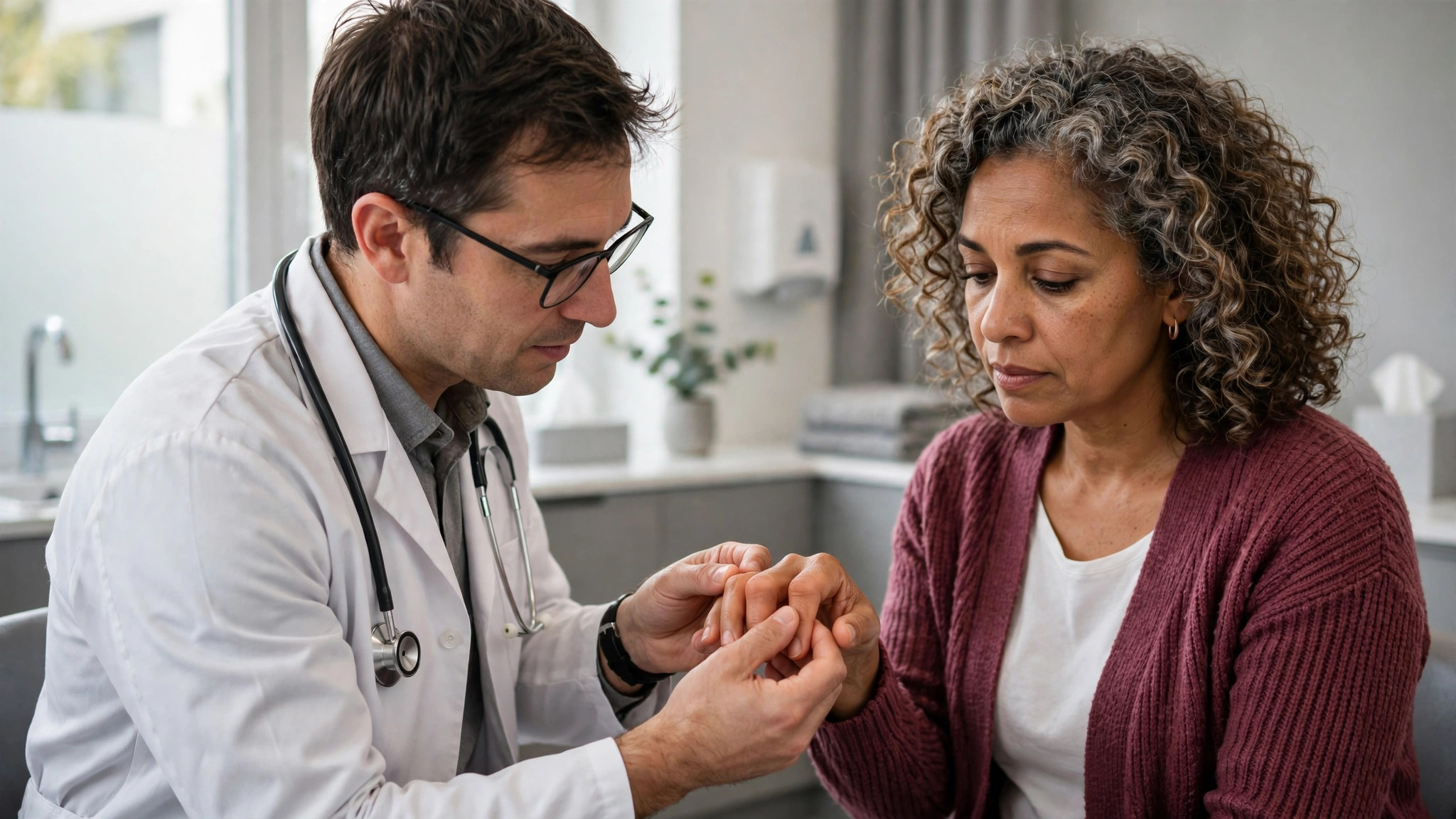
Assessment examines the joints, tests grip and tendon glide, and uses bloods (inflammation markers, rheumatoid factor and anti-CCP, uric acid where gout is suspected) plus imaging where the pattern demands. Early inflammatory arthritis treated early is a different disease from the same arthritis treated late, which is why fingers earn their blood tests readily. The NHS fibromyalgia overview explains how rheumatology referrals fit your care.
Quick Questions
My fingers feel swollen but look normal. Is that real?
Yes, and it is one of this condition’s best-documented small torments: the sensation of swelling, from fluid shifts, nerve sensitivity and the brain’s swollen-feeling interpretation of amplified signals, without measurable inflammatory swelling underneath. Rings are the honest witnesses, genuinely tighter on the worst mornings from the overnight fluid pattern, back to normal by midday. What changes the category is swelling you can photograph: persistent, visible, joint-centred, still there at noon. Keep a dated photo on the good days and the bad; the comparison settles arguments that memory cannot.
How long should morning stiffness last before I worry?
Duration is the dividing line clinicians actually use. Mechanical and fibromyalgia stiffness typically loosen within minutes of moving and warming, rarely beyond half an hour. Inflammatory arthritis stiffness characteristically lasts an hour or more, improves with use, and returns after rest in the day, the gelling pattern. If your fingers regularly need more than an hour to come online, that single fact earns blood tests whatever the rest of the picture looks like, because it is the cheapest high-value clue in rheumatology.
Are the bony lumps on my finger joints dangerous?
Almost always they are osteoarthritis signing its work: Heberden’s nodes at the end joints, Bouchard’s at the middle, arriving with midlife, family history and years of use. They can ache while they form, sometimes for a year or two, then usually quieten into painless furniture. They do not damage the hand’s future the way inflammatory swelling does, and they need no blood tests by themselves. Show them once, have the pattern named and recorded, and then let them be lumps rather than omens; new rapid swelling around them, heat, or several joints flaring together is a different event and reopens the assessment list.
Can fibromyalgia cause trigger finger?
Not directly, but the company it keeps can: trigger finger is a tendon-and-pulley problem, commoner with diabetes, thyroid trouble and repetitive gripping, all of which travel alongside fibromyalgia often enough that the two meet constantly. The distinction matters because trigger finger has specific, effective treatments, splinting, steroid injection, and a small operation with an excellent record, which no amount of general pain management replaces. A clicking, catching or locking finger is a mechanical complaint asking for a mechanical answer.
Living with fibromyalgia and finger pain means your hands keep misreporting their age. Warm the hands of your fibromyalgia and finger pain first, move them, strengthen them, share their load with every tool that helps, and let long morning stiffness, true swelling or a locking finger bypass every queue in this article for the blood tests and specific treatments that settle the question. If you are still building your wider plan, our first-year roadmap is a steady place to continue.
This article is for general information and education only and is not medical advice. A single hot swollen joint, or finger stiffness lasting over an hour each morning, needs prompt medical assessment.