Fibromyalgia and Low Libido: When Desire Goes Quiet
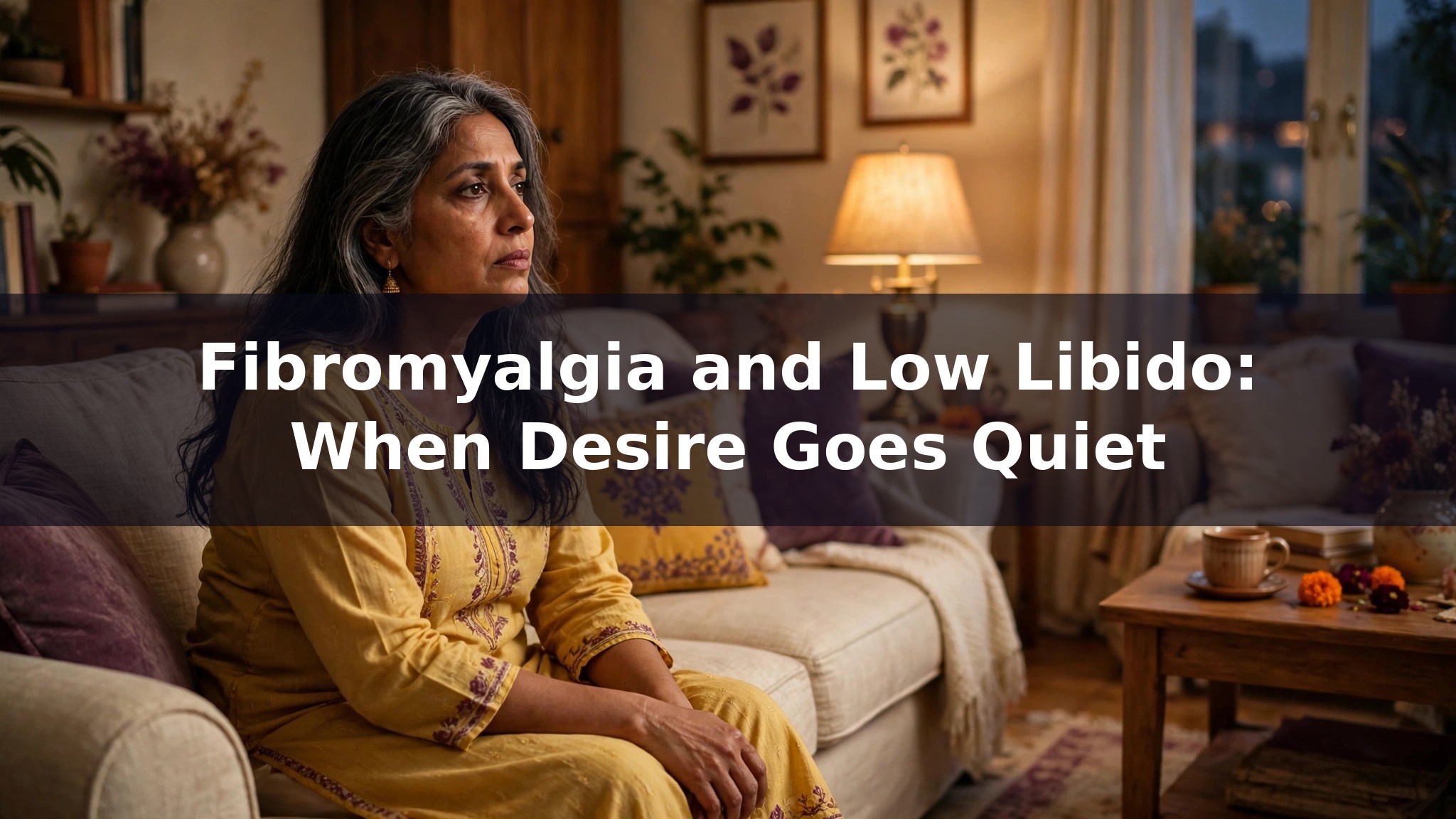
If you live with fibromyalgia and low libido, the quietest loss in the condition is the one nobody asks about. Desire does not leave dramatically; it thins, postponed by pain tonight, by exhaustion tomorrow, by the arithmetic of a body whose comfort is spent by six in the evening, until a couple who love each other find themselves affectionate, loyal, and quietly bereft of a whole register of their life together, each privately wondering whether the other has stopped wanting, or stopped wanting them.
Desire is a whole-body verdict, not a switch, and fibromyalgia argues against it on every channel at once. Pain bids against it, fatigue outbids it, broken sleep taxes it, mood flattens it, and several of the standard medicines for this condition, certain antidepressants above all, lower it pharmacologically as a known side effect. Add the pelvic pain and hormonal chapters many readers carry, and a low libido in this population is not a mystery or a verdict on a relationship; it is one of the most predictable symptoms nobody mentions.
This guide explains how fibromyalgia and low libido connect. First, you will learn the seven main reasons desire fades in chronic pain. Next, you will find the rebuilding steps, medicine reviews, communication tools, and timing strategies that genuinely help. Finally, you will learn which changes deserve medical investigation in their own right, from hormones to depression.
Table of Contents
- Why Fibromyalgia and Low Libido Come Together
- 7 Reasons Desire Fades in Chronic Pain
- What It Feels Like Day to Day
- Fibromyalgia and Low Libido: Rebuilding Desire Patiently
- Changes Worth Investigating in Their Own Right
- Quick Questions
Why Fibromyalgia and Low Libido Come Together
Start with the body’s budget, because desire is discretionary spending, which is where fibromyalgia and low libido properly begin. A nervous system triaging pain, poor sleep and exhaustion cuts the non-essential accounts first, and evolution files reproduction under postponable whenever survival systems are loud. This is not psychology or relationship commentary; it is the same neuroendocrine maths that lowers libido in depression, thyroid disease and chronic stress, and the NHS loss of libido guide lists chronic illness, pain and fatigue among its standard causes for exactly this reason.
The medicines deserve their own paragraph because they are the most fixable item here. Serotonin-raising antidepressants, several of which are prescribed for fibromyalgia pain and sleep, commonly blunt desire and delay or erase orgasm; some pain medicines and blood pressure tablets contribute too. Nobody should stop a working medicine over this article, but everybody is entitled to the conversation: dose timing, alternative agents and add-on strategies exist, and prescribers cannot fix a side effect they are never told about.
Men reading this page exist in growing numbers and deserve their sentence: the same budget maths applies, compounded by testosterone’s slow decline under chronic illness and by erectile reliability becoming its own source of anticipatory anxiety, so that desire retires partly to avoid a test it fears failing. Every item in this article’s rebuilding programme applies unchanged, and the medicine review matters doubly, because several relevant culprits sit in the standard male prescription list as well.
The pelvic and hormonal chapters complete the wiring. Our fibromyalgia and pelvic pain guide covers the pain-with-intimacy overlap that makes desire rationally cautious, and our menopause and fibromyalgia guide covers the oestrogen fall that dries tissues and lowers desire together, the double blow that arrives for so many readers in the same season as their worst flares. Desire, in short, is downstream of nearly everything this website treats, and it recovers downstream too.
7 Reasons Desire Fades in Chronic Pain
Most people with fibromyalgia and low libido have several of these at work. Naming them separately matters, because each has a different remedy. In fibromyalgia and low libido, pain opens the bidding against desire:
1. Pain itself. Anticipated and actual: a body expecting touch to hurt declines touch in advance, and allodynia can make even affectionate contact register as assault.
2. Exhaustion and broken sleep. Desire needs surplus energy, and the fibromyalgia day rarely closes in surplus; the evening crash retires the topic before it is raised.
3. Medicine side effects. The antidepressant and medication story above: desire lowered, arousal slowed, orgasm delayed, each pharmacologically ordinary and individually negotiable.
4. Mood and self-image. Depression and anxiety flatten wanting generally, while a body that feels unreliable, heavier, older than its years, quietly withdraws from being seen.
5. Hormones and life stage. Menopause, thyroid shifts, testosterone decline with age and illness: the chemical floor of desire moving under everything else in this list.
6. Pain with intimacy itself. Pelvic pain, vaginal dryness, and post-activity flares teach avoidance efficiently; desire protects the body by retiring before the evidence.
7. Relationship weather. The caregiver-patient drift, unspoken resentments about cancelled plans and uneven loads, tenderness thinned by years of logistics: desire follows the relationship’s climate, not only the body’s.
Notice what is absent from the list: a failure of love, effort or attraction, the three defendants the silence usually charges. Desire here is an output with inputs, pain, energy, chemistry, comfort, climate, and outputs recover when inputs are repaired, which is the most hopeful sentence this page owns.
What It Feels Like Day to Day

Day to day, fibromyalgia and low libido are experienced less as an absence than as a negotiation conducted in silence. Live with fibromyalgia and low libido and the quiet itself becomes the loudest part. One partner stops initiating to avoid pressuring; the other stops mentioning it to avoid complaining; both privately translate the quiet into rejection, and the translation, repeated nightly, does more damage than the symptom. Touch itself gets rationed into the practical, medication rubs, help with shoes, a hand on a painful shoulder, until affection’s vocabulary shrinks to nursing.
Single readers are not exempt from the symptom, only from its negotiations. Desire fading matters even without a partner: it is information about medicines, hormones and mood, and it is also a part of aliveness people miss on their own behalf, in their own body, without any audience at all. The rebuilding programme on this page is written for them equally; only the conversation step changes its address, from a partner to a clinician, and it loses none of its importance in the move.
The comparison machine runs alongside: friends’ jokes, films, the memory of one’s own earlier decades, all filing the current quiet under failure. What almost nobody in the situation says aloud is how intact the love usually is underneath, and how mechanical the obstruction above it has become. That is why this symptom, of all the ones on this site, improves fastest when it is simply discussed, because half its mass is silence.
Fibromyalgia and Low Libido: Rebuilding Desire Patiently

Desire in this condition is rebuilt the way fitness is: small, scheduled, and without drama. For people managing fibromyalgia and low libido, the programme that works is below. In fibromyalgia and low libido, the medicine list is the first suspect:
Hold the medicine review you have been postponing. Bring a list, name the sexual side effects plainly, and ask what can be adjusted, retimed, substituted or counterbalanced. This single appointment resolves more cases than every other step in this section combined, and prescribers regard it as routine medicine, not embarrassment.
Schedule around the pain, not against it. Desire follows the body’s better hours, which in fibromyalgia are rarely midnight. Warmth first, a bath or heat pad lowering the pain bid, timing inside the window after pain relief works: unromantic logistics that romance quietly depends on, here as everywhere.
Rebuild touch below the threshold of expectation. Affection with no destination, massage, hand-holding, shared warmth, re-teaches a guarded nervous system that contact predicts pleasure rather than pain or obligation. Therapists call it graded intimacy; couples who do it call it getting each other back, one pressure-free evening at a time.
Treat the local mechanics. Lubricants and vaginal moisturisers for dryness, pelvic physiotherapy for pain with intimacy, positions chosen around painful joints and tender points. Desire follows comfort more faithfully than it follows novelty, and comfort is mostly engineering.
Talk in the daytime, briefly and kindly. One honest conversation, held outside the bedroom and outside the moment, replaces months of mutual translation: what hurts, what is medicine, what each of you misses, what the plan is. Our fibromyalgia and period pain guide makes the same point for cycle-linked flares; bodies are easier to accommodate once they are discussed on the record.
Write your partner one honest paragraph. If the conversation stalls in person, a short written note, what has changed, what has not, what you are booking and trying, does the same work on paper. Couples rebuilding fibromyalgia and low libido around a shared text stop translating silence into rejection, because fibromyalgia and low libido lose half their power the moment both people are reading the same page.
Refill the accounts desire spends. Sleep protected, flares paced, mood treated in its own right, movement kept: the whole fibromyalgia programme is, among its other merits, a libido programme, because it returns the surplus that desire is made of. Expect the return to lag the effort by weeks, and do not grade a month’s rebuilding by one evening.
Changes Worth Investigating in Their Own Right
Most fibromyalgia and low libido is the budget, the medicines and the climate. Nevertheless, ask for investigation if you notice:
- A sudden change in desire rather than a gradual fade, especially with new medicines, new fatigue, weight change or hair and skin changes, which can mark thyroid or other hormone shifts
- Erectile difficulties that are new or progressive, which can be an early vascular signal and deserve assessment on those grounds alone
- Pain with intimacy that is new, one-sided, or accompanied by bleeding, discharge or a pelvic mass feeling
- Loss of desire travelling with persistently low mood, anhedonia beyond the bedroom, or thoughts of self-harm, which is depression asking to be treated directly
- Any sexual change accompanied by neurological symptoms or new severe headaches and visual change, a rare but real hormonal pattern
Assessment covers a medicine review, hormone and thyroid bloods where the pattern suggests, and mood screening, with psychosexual therapy available where the knot is relational. The NHS fibromyalgia overview explains how these referrals sit within your wider care. None of these conversations will be the most embarrassing thing your doctor hears this week; they will barely rank.
Quick Questions
Is low libido just part of fibromyalgia I have to accept?
It is common in fibromyalgia, which is a different statement. Common causes here include a medicine with a known, negotiable side effect, an untreated hormone shift, pelvic pain with an available physiotherapy answer, and a silence with an available conversation. Accepting the whole bundle without unpacking it is the only version of this symptom that deserves the word permanent. Most people who work through the list recover a version of their intimate life they are genuinely content with, usually quieter in frequency and better in quality than the memory they were grieving.
Should I stop my antidepressant if it is lowering my libido?
Never abruptly, and never unilaterally: sudden stops cause withdrawal syndromes and the return of the pain, sleep or mood problem the medicine was carrying. The correct move is the review appointment, where dose, timing, switching to agents with lower sexual side-effect rates, and adjunctive strategies are all on the table. Prescribers manage this trade-off weekly; what they cannot do is manage it for a patient who protects them from hearing about it.
Can hormone treatment help low libido?
Sometimes, where a measured deficiency is actually the floor that gave way: menopausal hormone therapy can restore desire indirectly through sleep, mood and tissue comfort, and testosterone treatment has defined roles in carefully assessed cases. What hormones cannot do is substitute for the medicine review, the pelvic mechanics and the conversation, which is why assessment sequences them rather than leading with a blood result. Ask for the tests where the pattern fits; treat what they find; keep the rest of the programme running either way.
How do I raise this with a partner who thinks I have gone off them?
Directly, kindly, and with the mechanism named: my body is spending everything on pain and sleep, one of my medicines lists this as a side effect, and none of it is a verdict on you. Share this article if the words stick. Then make the plan together, the review appointment, the graded touch, the timing changes, because a plan converts an accusation into a project, and couples are measurably better at projects than at silences.
Living with fibromyalgia and low libido means an important register of life has gone quiet for mechanical, medical and conversational reasons, most of them addressable. Review the medicines behind your fibromyalgia and low libido first, investigate the sudden changes, rebuild touch below expectation, and hold the daytime conversation. Desire, in this condition, rarely needs rescuing; it needs its obstacles itemised. If you are still building your wider plan, our first-year roadmap is a steady place to continue.
This article is for general information and education only and is not medical advice. Never stop prescribed medicines suddenly; discuss side effects and sudden changes in desire with your prescriber or doctor.